How Professionals Can Earn Globally Through Remote Medical Coding
Introduction: A Career Path That Quietly Went Global
Not long ago, medical coding was something you’d only hear about inside hospitals and billing departments. It was office-bound, repetitive, and very location-dependent. That picture has changed completely.
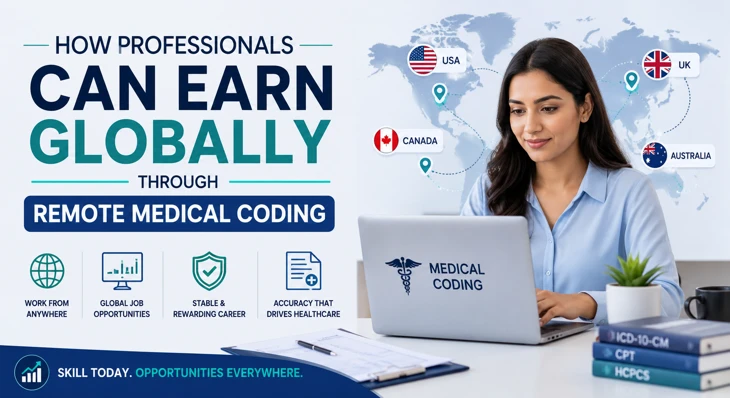
Today, remote medical coding has become one of those rare career options where geography matters far less than skill. A trained coder in India, the Philippines, or any other region can now support healthcare systems in the United States, Canada, the UK, or Australia without ever setting foot in a hospital abroad.
What makes this shift interesting is not just technology, but necessity. Healthcare systems are dealing with increasing volumes of patient data, strict insurance rules, and constant documentation pressure. They need accuracy more than ever—and that’s exactly where remote medical coding professionals step in.
For people looking for a stable global career that can be built from home, this field is quietly becoming a serious option.
What Remote Medical Coding Actually Means in Real Life
At its simplest, remote medical coding is the process of turning medical reports into standardized codes used for billing and insurance purposes. These codes come from systems like ICD-10, CPT, and HCPCS.
But if you strip away the technical definition, the work is more like translating complex medical stories into a language that insurance systems understand.
A typical day for a remote medical coder might include reviewing patient discharge summaries, checking physicians' notes, and assigning the correct codes so hospitals can be reimbursed accurately.
It sounds structured—and it is—, but it also requires judgment. Two similar-looking reports can sometimes require completely different coding decisions.
A junior coder once described it as “solving small puzzles all day, but every puzzle has financial consequences.” That description is not far from reality.
Why Global Remote Medical Coding Jobs Are Growing So Fast
The rise of global remote medical coding jobs didn’t happen overnight. It’s the result of several shifts occurring simultaneously in healthcare systems worldwide.
One of the biggest changes is the use of digital records. Hospitals have moved almost entirely to electronic health systems, which means every patient interaction now generates data that must be properly coded.
At the same time, healthcare demand is increasing. More patients mean more reports, and more reports mean more coding work.
There’s also a practical business reason behind it. Hospitals and insurance companies in developed countries often outsource coding work to trained professionals in other regions to reduce costs without sacrificing accuracy.
And then there’s regulation. Insurance claims are strict. A small coding error can delay payments or even cause rejections. That pressure keeps demand for skilled coders consistently high.
Skills That Actually Matter in This Career
Remote medical coding is not about typing speed or data entry. It’s more about understanding and precision.
The foundation always starts with medical knowledge. You don’t need to be a doctor, but you do need to understand how the human body, diseases, and treatments are described in medical language.
Then come coding systems like ICD-10, CPT, and HCPCS. These are the tools of the trade. Learning them properly takes time, but once they click, the workflow becomes much smoother.
Attention to detail is where many people either succeed or struggle. A single wrong digit can change the meaning of a code completely.
There’s also a thinking aspect. Medical reports are not always clean or straightforward. You often have to interpret what’s written and decide the most accurate coding path.
And since this is a remote role, basic comfort with software tools and communication platforms is important as well. Teams are often spread across countries and time zones.
Certifications That Open Global Opportunities
In this field, certification is not just a formality—it often decides how far you can go.
The CPC (Certified Professional Coder) is one of the most widely recognized certifications globally. Many international employers specifically look for it when hiring.
The CCS (Certified Coding Specialist) is more focused on hospital-level coding and complex cases. It’s often preferred for more advanced roles.
CIC (Certified Inpatient Coder) is another specialized certification that focuses on inpatient hospital documentation.
For beginners, diploma-level medical coding courses can be a good starting point. They help lay the foundation before moving on to global certifications.
What matters most is not just collecting certificates, but actually applying what you learn in real coding scenarios.
How Most People Actually Enter This Field
Very few people wake up one day and start working as remote medical coders. It usually follows a gradual path.
It often begins with learning medical terminology. Even basic familiarity with how doctors describe conditions makes a big difference.
After that, structured training helps connect theory with practice. This is where ICD-10, CPT, and HCPCS start making sense.
Once training is complete, certification becomes the next step. This is what helps open doors to global remote medical coding jobs.
From there, practice becomes essential. Many professionals start with sample cases or entry-level roles just to build confidence.
Eventually, applications for remote positions begin. These are often offered by outsourcing companies, insurance providers, and healthcare service firms.
Over time, a simple profile turns into a global career.
Income Potential: What Professionals Can Expect Over Time
One of the main reasons people explore this field is income stability.
At the entry level, earnings are usually modest because the focus is on learning and accuracy rather than speed.
As experience builds, so does responsibility. Mid-level professionals start handling more complex coding cases, which naturally leads to better compensation.
Senior coders, especially those working with international healthcare systems, often earn significantly higher incomes due to their accuracy and expertise.
There is also freelance remote coding, where professionals work with multiple clients. This can create flexible and sometimes higher earning potential depending on workload and skill level.
The important thing to understand is that income in this field is skill-driven. The more accurate and efficient you become, the more valuable you are.
Where Remote Medical Coders Work Today
Remote medical coders are no longer limited to hospitals.
They are now part of a broader healthcare ecosystem that includes:
Hospitals and healthcare systems managing patient records
Medical billing companies handling insurance claims
Insurance providers verifying and processing data
Healthcare outsourcing firms supporting international clients
Telehealth companies managing digital consultations
This wide demand is what makes remote medical coding a truly global career option.
Challenges You Should Know About
Like any profession, this one comes with its own learning curve.
Medical language can feel overwhelming at first. Many beginners struggle with terminology, but this usually improves with practice.
Accuracy pressure is real. The expectation is not just to work, but to work correctly. That level of responsibility can take time to adjust to.
Working across time zones can also feel different at first, especially when collaborating with international teams.
And because coding guidelines change over time, continuous learning becomes part of the job.
The good news is that most of these challenges become routine once you get comfortable with the workflow.
Practical Ways to Grow Income in This Field
Career growth in remote medical coding is very practical and skill-based.
Updating certifications regularly helps open better roles.
Specializing in complex areas like inpatient or surgical coding can increase earning potential.
Gaining international experience adds credibility and trust.
Improving speed while maintaining accuracy makes you more valuable to employers.
Some professionals also take on freelance projects alongside their full-time work to diversify their income.
Future of Remote Medical Coding Careers
Even with AI tools entering healthcare, this profession is not disappearing.
Technology can assist, but it cannot fully replace human interpretation of medical records. Context, judgment, and compliance decisions still require trained professionals.
In fact, the role is becoming more refined rather than reduced.
Remote medical coding is expected to remain a stable and globally relevant career path for years to come.
Conclusion: A Quietly Powerful Global Career Option
Remote medical coding is not a flashy career, but it is a dependable one.
It offers flexibility, global exposure, and long-term stability for those willing to learn the skills properly.
There are no shortcuts here, but there is a clear path. With the right training, certification, and consistent practice, professionals can build a career that connects them to healthcare systems worldwide—all without leaving home.
FAQs
1. Can someone start remote medical coding without experience?
Yes, beginners can enter with proper training and certification.
2. Is remote medical coding really a global career?
Yes, professionals work with healthcare systems across multiple countries.
3. Which certification is most widely accepted?
CPC is one of the most recognized globally.
4. Do you need a medical degree?
No, but knowledge of medical terminology is essential.
5. Can this work be done fully from home?
Yes, most roles are fully remote.
6. How long does it take to become job-ready?
Typically a few months to a year depending on training and practice.