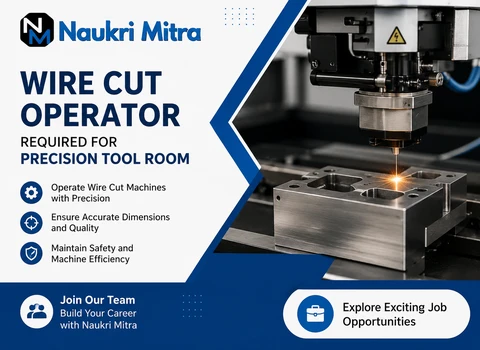
What Does a Wire Cut Operator Actually Do?
Ask ten people what a Wire Cut Operator does, and most will have no idea. That's fine, because it's not a job most people encounter unless they work in manufacturing. In simple terms, this person operates a Wire EDM machine, a piece of equipment that cuts through hardened steel with an electrically charged wire rather than a blade. There's currently a Full-time opening for this role in Coimbatore, Tamil Nadu, India, based in a precision tool room, and it's worth understanding what the work involves before applying.
The wire itself doesn't touch the metal in the way a saw would. Instead, it generates tiny electrical sparks that erode the material bit by bit. That's why this method can cut through carbide and tool steel that would destroy a regular cutting tool within seconds.
Why Tool Rooms Need This Skill
Dies, molds, punches, and fixtures all need shapes with sharp internal corners and tolerances measured in microns. No conventional machining process reliably gets there. So tool rooms and precision component manufacturers keep hiring operators who can set up a job correctly, read a drawing without hand-holding, and catch a problem before it ruins an expensive block of steel. Coimbatore has a fairly strong base of engineering and machine tool manufacturing, which is part of why openings like this one show up there regularly.
A Rough Sketch of the Workday
No two days are identical, but there's a pattern. Morning usually starts with checking the machine — wire spool, dielectric fluid level, and whatever job card is next in line. From there, the operator loads the material, sets the offsets, and either loads a pre-written program or edits one to match the drawing. Once cutting starts, it's mostly watching. A snapped wire or a drifting dimension needs to be caught fast, not discovered at the end of a three-hour cycle.
Toward the end of a job, the finished piece gets pulled and checked against the drawing using calipers, micrometers, or a height gauge. If it's within tolerance, it moves on. If not, someone has to figure out why.
The Instruments and Tools You'll Get Used To
Beyond the EDM machine itself, this role involves a fair amount of measurement work. Operators typically rely on:
- Vernier calipers and micrometers
- Height gauges and dial indicators
- Surface plates for setting reference points
- Basic hand tools for clamping and fixture adjustments
None of this is complicated once you've handled it a few times, but precision instruments punish carelessness, and a shaky reading can lead to a rejected part.
Who Fits This Role
Freshers with an ITI in a machining-related trade often start here, as do diploma holders in Mechanical or Tool and Die Engineering. That said, formal qualification isn't the whole story. Employers generally prefer candidates who've actually spent time near an EDM machine, whether during an internship, apprenticeship, or a previous job. Someone who can read an engineering drawing correctly and knows their way around measuring instruments tends to stand out more than someone with just a certificate and no hands-on exposure.
Where People With This Job Usually Work
You'll find this role in precision tool rooms, die and mold manufacturing setups, and general engineering workshops that supply components to larger industries. Automotive component makers also rely on wire cutting for certain jig and fixture work. It's not the kind of job tied to a specific sector — wherever tight-tolerance metal parts are needed, someone with this skill set is usually involved at some point in the process.
On Your Feet, Focused, and Sometimes on Shifts
This isn't a desk job. Expect to be standing for long stretches, handling small parts that require steady hands, and staying alert during cutting cycles that can run for hours with little visual activity. Depending on production load, shift work is common in this line of work. Most tool rooms keep the working environment fairly controlled, since even small temperature swings can throw off measurement accuracy, though coolant fluid and the low hum of machines are just part of daily life on the floor.
Staying Safe Around the Machine
Wire EDM involves electrical discharge and dielectric fluid, so this isn't an area where shortcuts make sense. Safety shoes, gloves, and eye protection are standard while handling parts and fixtures. During maintenance or wire changes, lockout procedures matter, and staying clear of the wire while the machine is running is basic common sense that's still worth repeating. Keeping the floor around the machine free of spilled fluid also reduces slip hazards that are easy to overlook until someone gets hurt.
What Trips Up Beginners
Wire breakage is probably the most common frustration for anyone new to this trade, often caused by incorrect tension settings or a misaligned workpiece. Misreading a drawing or entering the wrong offset is the other classic mistake, and it tends to happen when someone rushes the setup instead of double-checking before hitting start. The operators who get good at this job aren't necessarily the fastest — they're the ones who slow down at the setup stage and speed up everywhere else.
Growing Within the Trade
This role isn't a dead end. Operators who put in consistent, careful work over a few years often move into programming, quality inspection, or eventually supervising a tool room floor. Exposure to different materials and machine types along the way tends to open more doors than staying narrowly focused on a single job type.
Pay and What Else Might Come With It
This particular opening is Full-time, based in Coimbatore, Tamil Nadu, India, with a monthly salary of ₹28,500. Beyond the base pay, some employers offer extras like overtime, PF, ESI, bonuses, uniforms, transport, or canteen access — none of these are guaranteed in every workplace, so it's worth clarifying directly during the hiring process rather than assuming.