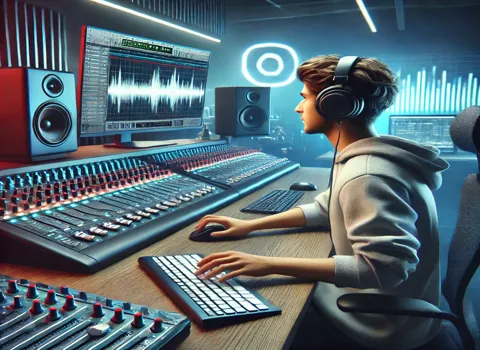
A creaking floorboard. A sudden crack of thunder. The half-second of silence right before something jumps out. None of that happens by accident — someone builds it, sound by sound, until a game world feels real enough to forget it isn't. That's the work of a Virtual Game Sound Designer.
What this role is about
Sound isn't decoration on top of a game — it's part of how the story gets told. You'll shape the audio that guides how players feel in any given moment: tension building before a fight, relief after surviving one, the small satisfying click of a reload. Players rarely notice good sound design directly. They just feel it working, scene after scene.
What you'll be building
- Interactive sound effects that respond to in-game actions and player choices.
- Layered environmental audio that makes game spaces feel lived-in — footsteps, ambient noise, distant chatter.
- Directional and spatial audio so players can sense distance and location without a visual cue.
- Cinematic mixes that shift naturally between quiet, restrained moments and full-scale set pieces.
- Original music cues when a scene calls for something composed rather than sourced.
Some of the best sound design starts with unconventional sources — snapping celery for a bone crack, dropping a brick in sand to nail a footstep's weight. If it gets the right reaction, the method doesn't matter.
Tools you'll work with
- Foley recording setups for authentic, scene-specific sound effects.
- Real-time mixing tools to balance clarity against chaos in fast-moving scenes.
- Sound implementation within Unity and Unreal Engine, so audio lives directly in gameplay rather than sitting in a file.
- Standard audio production and editing software for building and refining sound assets.
What you'll need to bring
Minimum qualification:
Bachelor's degree in audio engineering, sound design, music production, or a related field. Candidates with strong equivalent hands-on experience will also be considered.
Experience: a minimum of
3 years working in sound design, audio production, or game audio specifically.
Technical skill matters, but so does how you think about sound. This role suits people who:
- Notice small audio details — the echo in a cave, the weight of a footstep, the tension a silence creates.
- Treat sound as storytelling, not just technical execution.
- Stay curious enough to try an odd idea just to see if it lands.
- Adapt easily when a scene, deadline, or creative direction shifts mid-project.
- Take feedback well and iterate quickly when a mix isn't landing yet.
Skills required
- Strong working knowledge of Foley recording, sound effects design, and audio mixing.
- Experience with sound implementation in Unity or Unreal Engine.
- Comfort with 3D and spatial audio techniques.
- Solid grasp of adaptive or interactive audio systems that respond to gameplay.
Skills that set you apart
- Original music composition experience for games or interactive media.
- Background working across multiple platforms, including console and VR audio.
- Experience leading or mentoring within a sound design team.
- A portfolio that demonstrates range — quiet, restrained work as well as large-scale cinematic mixes.
What your first week looks like
Day one is mostly setup — meeting the team, getting your gear configured, and walking through the current audio pipeline. By day two or three, you're testing sound implementation directly in Unity or Unreal. Day four usually means joining a brainstorm on an upcoming feature, and by day five, you'll have built your first interactive sound effect and watched it play out in a live build. It moves fast, on purpose.
How the team works
This is a remote role, but not a solitary one. You'll be in regular contact with writers, coders, and artists, bouncing ideas around in small huddles rather than working from a brief in isolation. Sound is treated as a core part of the story here, not an afterthought bolted on at the end. Job seekers exploring creative remote roles on platforms like Naukri Mitra will find this kind of collaborative setup is exactly what separates a strong sound design position from a purely freelance one.
Compensation and benefits
This role pays
$95,000 annually. Along with the salary, you'll get:
- Full remote flexibility to work from wherever you do your best creative work.
- Access to professional-grade, regularly updated audio tools and software.
- Room to experiment and test unconventional ideas without excessive gatekeeping.
- Genuine recognition for wins — not just a passing mention, but real acknowledgment from the team.
Where this role can take you
Sound designers who grow in this role often move into leading audio teams on larger titles, specializing in adaptive music systems, or expanding into VR and cross-platform audio work. Others become the go-to person for cinematic audio on high-stakes releases. Mentorship and resources are built into the role, so growth isn't left to chance.
Apply for this role
If you've ever heard a sound in everyday life and immediately thought about how it would work in a game, this role is built around that instinct. Send through your application along with a portfolio or reel of your strongest work, and the team will follow up with next steps.
Worldwide career opportunities: talented professionals from the USA, Canada, UK, EU nations, Australia, India, and many other regions are encouraged to apply.