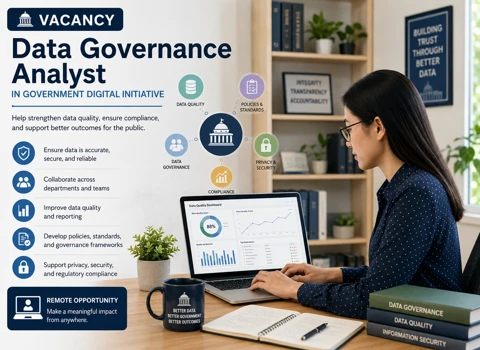
Building Reliable Data Foundations for Government Digital Services
The Vacancy for a Data Governance Analyst in the Government Digital Initiative focuses on helping public organizations manage information in a structured, secure, and dependable way. As government agencies modernize services, move systems to the cloud, and expand digital access for citizens, the need for well-governed data continues to grow.
Every government department depends on accurate information. Data supports public programs, financial planning, service delivery, regulatory oversight, and policy development. When records are inconsistent, outdated, or poorly managed, agencies can face reporting errors, operational inefficiencies, and reduced public confidence.
A Data Governance Analyst works behind the scenes to establish standards that improve data quality and ensure information is handled responsibly. This
remote position offers a rate of $45 per hour and provides an opportunity to contribute to projects that directly support public-sector modernization.
The Growing Importance of Data Governance in Public Agencies
Government organizations manage vast collections of information every day. These records may include citizen applications, tax information, healthcare data, transportation records, licensing details, workforce information, and much more.
Managing such large volumes of information requires clear oversight. Data governance provides the framework that defines how information should be collected, stored, maintained, shared, and protected throughout its lifecycle.
Organizations hire Data Governance Analysts to help:
- Create consistent standards for data management
- Improve the reliability of reports and analytics
- Support legal and regulatory requirements
- Reduce risks associated with poor-quality data
- Strengthen privacy and security controls
- Improve coordination between departments
- Increase trust in organizational information
Without governance practices in place, agencies often encounter duplicate records, conflicting definitions, inconsistent reporting, and uncertainty about who is responsible for managing critical data assets.
Helping Government Modernization Projects Succeed
Digital transformation initiatives are common across the public sector. Agencies are upgrading legacy systems, introducing online services, improving data-sharing capabilities, and adopting advanced analytics tools.
However, technology upgrades alone do not guarantee success. Reliable outcomes depend on reliable information.
A Data Governance Analyst contributes by ensuring that data remains accurate, consistent, and properly managed throughout these projects.
Typical contributions include:
- Defining ownership for important datasets
- Developing governance policies and procedures
- Establishing business rules and data standards
- Supporting metadata and data catalog initiatives
- Monitoring data quality performance
- Reviewing compliance with governance requirements
These efforts help agencies gain greater value from their technology investments while reducing operational risks.
Understanding the Scope of the Role
The Vacancy for a Data Governance Analyst in the Government Digital Initiative blends analytical work, policy development, collaboration, and oversight responsibilities.
Professionals in this role often spend time:
- Designing governance frameworks
- Reviewing data quality measurements
- Maintaining governance documentation
- Supporting data stewardship activities
- Identifying compliance gaps
- Conducting governance reviews
- Monitoring adherence to standards
- Assisting with privacy and security initiatives
- Preparing reports for management teams
- Recommending improvements to existing processes
Some positions focus heavily on governance operations, while others are tied to specific modernization programs or enterprise-wide data initiatives.
Collaboration Across Departments
Data governance touches nearly every area of a government organization. Because of this, analysts regularly work with a wide range of stakeholders.
Common partners include:
- Information technology teams
- Data architects
- Data engineers
- Business analysts
- Compliance officers
- Cybersecurity specialists
- Project managers
- Department executives
One of the most valuable skills in this profession is the ability to explain governance concepts in practical terms that different audiences can understand.
What Daily Work Often Involves
The day-to-day responsibilities of a Data Governance Analyst can vary depending on organizational priorities and project timelines.
Common activities include:
- Reviewing data quality dashboards
- Investigating inconsistencies in records
- Updating governance policies and standards
- Participating in stakeholder meetings
- Maintaining data inventories and catalogs
- Supporting audit preparation efforts
- Tracking governance metrics
- Creating process documentation
- Coordinating governance initiatives across teams
Because this role is remote, much of the work is completed through collaboration platforms, virtual meetings, and shared documentation systems.
An Example From a Government Project
Consider a government agency launching a new online permit application system.
A Data Governance Analyst may be responsible for:
- Identifying who owns and manages permit-related data.
- Defining validation rules for submitted information.
- Ensuring privacy requirements are incorporated into workflows.
- Creating metadata documentation for reporting purposes.
- Monitoring data quality after implementation.
These actions help improve consistency, reduce errors, and support accurate reporting.
Knowledge Areas That Strengthen Performance
Employers typically seek candidates who understand both governance principles and broader data management practices.
Important areas of knowledge include:
- Data governance frameworks
- Data quality management
- Metadata management
- Master data management (MDM)
- Data lineage concepts
- Information lifecycle management
- Privacy and compliance requirements
- Risk management practices
- Data architecture fundamentals
- Reporting and analytics environments
Government environments often involve multiple systems and business units, making it important to understand how information moves throughout an organization.
Technology and Platforms Commonly Used
The tools used can differ between agencies, but many Data Governance Analysts work with platforms such as:
- Microsoft Purview
- Collibra
- Informatica Data Governance
- Alation
- Power BI
- Tableau
- SQL databases
- SharePoint
- Jira
- Confluence
- Microsoft Azure
- Amazon Web Services (AWS)
Experience with governance platforms, reporting tools, and cloud environments can be particularly valuable.
Educational Backgrounds Often Seen in the Field
There is no single path into data governance, but many professionals come from technology, analytics, compliance, or information management backgrounds.
Relevant degree programs include:
- Information Systems
- Computer Science
- Data Analytics
- Information Management
- Business Analytics
- Statistics
- Public Administration
Employers may also consider candidates who have developed expertise through practical experience in records management, compliance, data quality, or digital transformation projects.
Certifications That May Be Helpful
Professional certifications can demonstrate specialized knowledge and commitment to ongoing development.
Examples include:
- Certified Data Management Professional (CDMP)
- DAMA certifications
- Certified Information Privacy Professional (CIPP)
- Data Governance and Stewardship certifications
- Microsoft data certifications
- Certified Information Systems Security Professional (CISSP)
While not always required, these credentials can strengthen a candidate's profile and deepen technical understanding.
Common Obstacles Faced by Data Governance Analysts
Data governance work often involves organizational challenges as much as technical ones.
Professionals frequently encounter situations such as:
- Different departments using different definitions for the same information
- Resistance to new governance standards
- Legacy systems with limited functionality
- Complex regulatory obligations
- Unclear ownership of data assets
- Historical data quality problems
- Competing priorities between accessibility and security
Addressing these issues requires patience, communication skills, and a methodical approach to problem-solving.
Encouraging Organizational Adoption
Creating governance policies is only the beginning. Long-term success depends on whether employees understand and follow those standards.
Analysts often support adoption efforts by:
- Providing guidance to stakeholders
- Delivering training sessions
- Explaining the purpose of governance initiatives
- Assisting teams with implementation
- Building relationships across departments
Organizations tend to achieve stronger results when governance is embedded in everyday operations rather than a separate compliance exercise.
Characteristics That Fit This Profession Well
The Vacancy for a Data Governance Analyst in the Government Digital Initiative is often well-suited to individuals who enjoy working with information, processes, and organizational improvement.
Professionals who perform well in this field commonly demonstrate:
- Strong attention to detail
- Analytical thinking
- Effective written and verbal communication
- Organizational skills
- Curiosity about how data is managed
- Critical thinking abilities
- Accountability and professionalism
- Collaborative working styles
Adaptability is also important because regulations, technologies, and governance practices continue to evolve.
Remote Work in a Data Governance Environment
Many government modernization programs now support remote and distributed teams. Much of the governance process can be managed effectively without being physically present in an office.
Remote Data Governance Analysts often spend their time:
- Attending virtual meetings
- Reviewing governance documentation
- Monitoring data quality indicators
- Collaborating through digital platforms
- Facilitating workshops and discussions
- Managing governance-related projects
Success in a remote setting depends heavily on communication, organization, and self-discipline.
Practices That Support Effective Remote Work
Professionals working remotely often benefit from:
- Maintaining thorough documentation
- Communicating regularly with stakeholders
- Using project management tools consistently
- Scheduling recurring progress reviews
- Following structured workflows
These habits help maintain visibility, accountability, and project momentum.
Organizations That Commonly Employ Data Governance, Analysts
Although this role is tied to government digital initiatives, the skills developed in data governance are valuable across many sectors.
Employers frequently include:
- Federal government agencies
- State and municipal governments
- Healthcare providers
- Financial institutions
- Educational organizations
- Utility companies
- Regulatory authorities
- Consulting firms
- Nonprofit organizations
- Public service entities
As organizations place greater emphasis on data quality, privacy, and compliance, demand for governance expertise continues to expand.
Advancement Opportunities Within the Profession
Data governance has become an increasingly strategic function within modern organizations. Professionals who build expertise in governance, compliance, and data management often have multiple avenues for advancement.
Potential career paths include:
- Senior Data Governance Analyst
- Data Stewardship Manager
- Data Quality Manager
- Information Governance Manager
- Enterprise Data Architect
- Data Strategy Consultant
- Director of Data Governance
- Chief Data Officer
Leadership skills, business knowledge, and technical expertise can all contribute to long-term career growth.
Contributing to Better Government Outcomes
Government agencies continue to invest in digital services, cloud infrastructure, analytics platforms, automation, and data-driven decision-making. None of these efforts can reach their full potential without dependable information.
The Vacancy for a Data Governance Analyst in the Government Digital Initiative offers professionals the chance to improve how public organizations manage data, strengthen accountability, support compliance efforts, and enhance service delivery. For individuals who enjoy creating structure, solving information challenges, and helping organizations make better use of data, this role provides meaningful work with a direct connection to public-sector improvement.
As digital government programs continue to expand, skilled Data Governance Analysts will remain essential to building trustworthy, secure, and effective information environments.