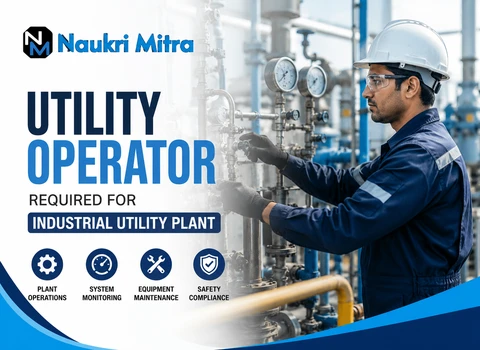
What Does a Utility Operator Actually Do in an Industrial Plant?
Anyone researching this career for the first time will find that a Utility Operator is one of the most essential people on an industrial site. This professional keeps a plant's background systems running smoothly, including water treatment units, steam boilers, compressed air systems, cooling towers, and power distribution systems. Without a reliable operator monitoring these utilities, the entire production process can slow down or stop completely. This particular opening is for a Utility Operator role at an industrial utility plant located in Jamnagar, Gujarat, India, offered on a Full-time basis.
Why Industrial Facilities Rely So Heavily on This Position
Large manufacturing units, refineries, and process plants cannot function without utilities being continuously available. A boiler that loses pressure, a water treatment system that fails, or a compressor that overheats can bring an entire production line to a halt. This is why companies actively recruit trained operators who can identify early warning signs, respond quickly, and keep utility systems stable around the clock.
A Typical Working Day on the Plant Floor
Most days begin with a round of checks across assigned equipment, noting pressure readings, temperature levels, and flow rates. An operator records these readings in log sheets, compares them against normal operating ranges, and reports any unusual patterns to the shift supervisor. Between these rounds, there is regular interaction with control panels, valves, pumps, and switchgear to keep everything functioning within safe limits.
Core Duties Handled by an Operator
- Starting, monitoring, and shutting down utility equipment as per procedure
- Reading gauges, meters, and digital displays to track performance
- Carrying out minor adjustments to maintain stable output
- Reporting abnormal sounds, vibrations, leaks, or temperature spikes
- Coordinating with maintenance technicians for repairs or servicing
- Maintaining cleanliness and orderliness of the equipment area
Where This Kind of Work Is Commonly Found
Utility operators are needed across chemical plants, petrochemical complexes, textile mills, food processing units, power generation facilities, and large manufacturing warehouses. Gujarat has a strong industrial base, and Jamnagar in particular hosts several process and manufacturing industries, making this a region where such technical roles are regularly available.
Machines, Instruments, and Tools Used on the Job
A plant operator typically works with boilers, air compressors, DM water plants, effluent treatment systems, cooling towers, and diesel generators. Measuring instruments such as pressure gauges, flow meters, thermometers, and multimeters are used daily to verify that systems are working correctly. Hand tools like spanners, wrenches, and lubrication equipment are also part of routine tasks.
Technical Skills That Employers Look For
A good candidate understands basic mechanical and electrical concepts, can read simple engineering drawings, and knows how to interpret gauge readings accurately. Familiarity with preventive maintenance schedules and an ability to troubleshoot minor faults independently are valued skills for any equipment operator.
Practical Workplace Skills That Matter Just as Much
Beyond technical knowledge, employers appreciate operators who communicate clearly during shift handovers, stay alert during long working hours, and follow standard operating procedures without shortcuts. Attention to detail often prevents small issues from becoming major breakdowns.
Suitable Educational Background
Depending on the complexity of the equipment involved, employers may prefer candidates with an ITI certification in a relevant trade, a Diploma in Mechanical Engineering, or equivalent vocational training. Practical exposure to engineering drawings and precision measuring instruments is often considered as valuable as formal qualifications, so freshers with hands-on training and experienced technicians are both considered for such positions.
Physical Demands and Shift Patterns
This is an active role that involves standing, walking across the plant floor, climbing platforms, and occasionally lifting moderate loads. Many industrial utility plants operate in rotational shifts, including night duty, so candidates should be comfortable adjusting to varying work timings.
Working Environment and Safety Practices
The work takes place around high-pressure systems, hot surfaces, and moving machinery, so safety awareness is non-negotiable. Standard PPE such as safety shoes, helmets, gloves, and ear protection is generally provided and expected to be worn at all times. Lockout-tagout procedures, fire safety drills, and hazard reporting are common parts of daily operations.
Common Challenges Faced on the Job
Extended shifts, exposure to noise and heat, and the pressure of responding quickly during equipment faults are realistic challenges. Staying calm in abnormal situations and following escalation procedures, rather than attempting unauthorized fixes, is important for both safety and career growth.
Building a Long-Term Career in Utility Operations
With experience, an operator can progress toward senior operator roles, shift-in-charge positions, or specialized utility maintenance roles within the same plant or industry. Continued learning about newer equipment and process improvements helps technicians stay relevant as facilities upgrade their systems over time.
Salary and Benefits Expected in This Role
This Full-time position in Jamnagar, Gujarat offers a monthly salary of ₹31,000. In addition to the fixed pay, industrial employers may offer possibilities such as overtime pay, PF, ESI, annual bonus, uniforms, and transport or canteen facilities, though these vary by organization and are not guaranteed.