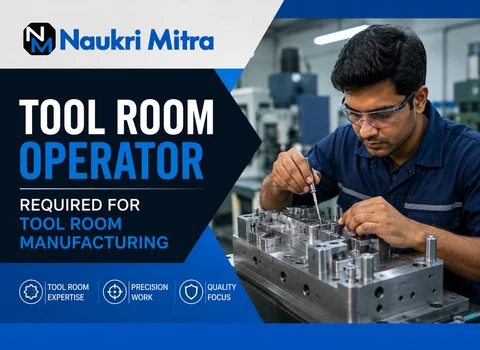
What a Tool Room Operator Actually Does
Walk into any precision manufacturing unit, and you'll usually find the tool room tucked in a corner, quieter than the main production line but arguably more critical. This is where dies, jigs, fixtures, and molds get made and repaired — the components that every other machine on the floor depends on to keep running. The Tool Room Operator role in Hosur, Tamil Nadu, India, sits right in the middle of that work. It's a Full-time position paying ₹29,000 a month, and it suits people who don't mind spending hours getting a single measurement exactly right.
Why This Job Exists in the First Place
A die that's off by even a few microns can ruin an entire downstream production batch. That's the real reason tool rooms matter so much to manufacturers — a mistake here doesn't stay small; it multiplies. Hosur has developed a fairly dense cluster of automotive component and engineering goods factories over the years, and most of them need at least a few people who can maintain that kind of tolerance day after day without cutting corners.
How the Day Usually Unfolds
Most shifts start with a job card or a drawing to study before anything else happens. Set up the machine, run a trial piece, check it against the drawing — sometimes the first attempt is fine, sometimes it isn't, and you adjust and try again. Through the shift there's a steady rhythm of machining, measuring, correcting, and recording output. Near the end, tools get cleaned and put away properly, and if the plant runs shifts, there's usually a quick handover to whoever's coming in next.
What the Job Actually Involves
- Reading engineering drawings and translating them into machine setups
- Running EDM (Electrical Discharge Machining) equipment, CNC mills, surface grinders, or lathes, depending on what the tool room has
- Checking dimensions with micrometers, vernier calipers, height gauges, and dial indicators
- Fabricating or repairing dies, punches, jigs, and fixtures
- Keeping machine logs and flagging anything unusual to a supervisor
- Sticking to the standard procedure for each job, even the routine ones
The Kind of Places Where This Work Happens
Tool and die manufacturing units, automotive ancillary factories, precision engineering workshops — that's the general territory. Tamil Nadu has a strong industrial base for this kind of work, and Hosur specifically has grown into a location where machining and tool-room skills stay in steady demand.
Machines and Instruments You'll Get Familiar With
EDM machines cut through hardened metal using controlled electrical sparks — useful for jobs where conventional cutting tools would struggle or wear out fast. Surface grinders handle flat-finishing work, lathes turn cylindrical parts, and CNC machines take over when a job needs to be repeated exactly, over and over, without drift. On the measuring side, bore gauges, slip gauges, and dial gauges are the everyday tools for confirming a part actually matches what the drawing says it should.
Training and Background That Tend to Help
Employers may prefer candidates with relevant machining or tool room training. Depending on the complexity of the work, an ITI in a machining-related trade, a Diploma in Mechanical or Tool and Die Engineering, or equivalent vocational training may be considered suitable. That said, practical experience with EDM machines, engineering drawings, and precision measuring instruments often counts for just as much as the certificate itself. Fresh ITI graduates are considered here regularly, and so are experienced hands who've spent years in tool rooms without ever having a formal diploma.
Skills That Don't Show Up on a Certificate
Patience matters more than people expect going in — some adjustments take several tries before they're right, and rushing usually makes things worse, not faster. Steady hands, decent eyesight for close inspection work, and the ability to read a drawing without someone explaining it help a lot. It also helps to get along with the production and quality teams, since tool room work rarely happens in isolation.
What the Body Goes Through
This is standing work, mostly, with some lifting and long stretches near running machinery. Shift work is fairly common depending on how the plant schedules production. Expect some noise, some machine coolant smell, and metal dust in the air — nothing unusual for a machining environment, but worth knowing going in.
Staying Safe Around the Machines
Safety glasses, gloves, safety shoes, and ear protection are the usual PPE near loud equipment. Lockout procedures before doing any maintenance, keeping the floor clear of oil, and never removing a machine guard just to save time — these aren't optional extras; they're what keeps the accident rate down in places that do this well.
The Hard Parts Nobody Mentions Upfront
Hitting tight tolerances consistently, especially under a deadline, takes longer to master than most newcomers expect. Machines break down at inconvenient times. Material batches aren't always as uniform as they should be. And misreading a drawing, even a small detail, can cost hours of rework. Most operators say the first few months are about building speed without losing the accuracy that got them the job in the first place.
Where This Can Lead Over Time
Operators who stick with it often move into senior operator roles, tool room supervision, or quality inspection within the same plant. Picking up additional machine skills — wire-cut EDM or CNC programming — tends to open up more options down the line.
On Pay and Benefits
The role pays ₹29,000 per month, Is Full-Time, and is based in Hosur, Tamil Nadu, India. Beyond the base salary, some employers in this line of work offer benefits like PF, ESI, overtime pay, bonuses, uniforms, transport, or canteen access — none of these are guaranteed at every company, but they're common enough to mention.
If You're Just Starting Out
Whether you're fresh out of ITI, hold a diploma, or already have a few years of shop-floor experience, tool room work is one of the more solid entry points into manufacturing in India. Getting comfortable with drawings, precision measurement, and machine handling early tends to pay off for years afterward.