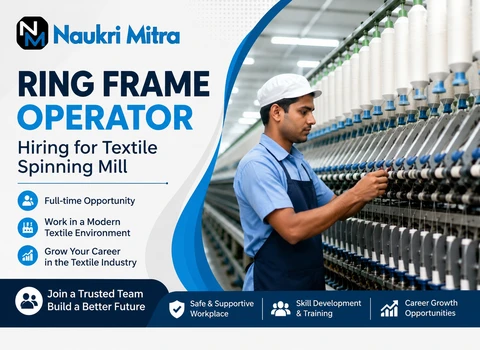
What a Ring Frame Operator Actually Does All Day
Walk into the spinning section of any textile mill, and the ring frame machines are usually the loudest and busiest part of the floor. This Full-time position, based in Coimbatore, Tamil Nadu, India, sits right at that stage of production. The job is simple to describe but not simple to do well: take roving, feed it through the ring frame, and turn it into usable yarn without letting quality slip.
It sounds mechanical. In practice, it's a lot of watching, listening, and reacting fast.
Why Mills Keep Hiring for This Position
Ring frames don't stop. They run shift after shift, and yarn quality depends on someone catching problems the moment they happen, not an hour later. A thread break that goes unnoticed for too long, a bobbin that overflows, a tension setting that drifts off — any of these can turn into wasted material or a batch that doesn't meet count specifications. That's really why this role exists. Machines can spin yarn on their own, but they can't tell when something's going wrong.
A Rough Outline of the Shift
No two shifts look identical, but most days on this job involve some combination of the following:
- Checking spindle speed and tension before production starts
- Watching for thread breaks and rejoining them without slowing the line
- Swapping empty roving bobbins for full ones
- Doffing — pulling filled yarn bobbins and loading empty tubes back in
- Spot-checking yarn count and uniformity through the shift
- Clearing fluff and lint buildup around the machine
Doffing, especially, is one of those tasks that looks easy until you're the one doing it under time pressure, with dozens of spindles to manage.
The Machine Itself, and What Sits Around It
A ring frame has a lot of moving parts worth knowing — spindles, travelers, rings, aprons, and the drafting rollers that stretch the roving before it gets twisted. Alongside the machine, operators also work with measuring tools such as a yarn count balance, a twist tester, and a lea strength tester, all used to confirm that the yarn coming off the machine actually meets spec. Doffing trolleys and bobbin carriers round out the daily equipment list.
Where This Stage Fits in the Bigger Picture
Yarn doesn't start at the ring frame. It gets there after passing through the blow room, carding, drawing, and roving stages first. By the time the material reaches the ring frame, it's already been cleaned and drafted down considerably — this is the stage where the final twist is applied, and the yarn takes its finished form. Get the twist or draft ratio wrong here, and the yarn's strength and fineness suffer.
Skills That Actually Matter on This Job
Understanding drafting and twist isn't enough on its own. What separates a good operator from an average one is usually hands-on: fast fingers for piecing broken thread, a trained eye that catches uneven yarn before a supervisor does, some basic troubleshooting instinct, and enough discipline to stick to procedure even when the floor gets hectic.
Who Tends to Do Well Here
Freshers can absolutely start in this role and learn on the floor. So can ITI candidates from spinning or textile-related trades, diploma holders in textile technology, and workers who've already spent time around spinning machinery elsewhere. Prior ring frame experience helps, but it's not always a strict requirement for someone starting out.
What the Work Environment Feels Like
Expect to be on your feet for most of the shift, moving along the machine length to keep an eye on multiple spindles at once. Spinning floors run warm and humid on purpose — the humidity keeps yarn from breaking too easily — and there's a constant background noise from the machines. Fine cotton fluff also floats in the air, which is part of why certain PPE isn't optional.
Shifts and Staying Safe
Mills usually run round the clock, which means shift rotation is part of the deal for a plant operator in this role — days, nights, and sometimes rotating schedules. On the safety side, that means earplugs, a cotton mask, and closed footwear as standard, and keeping loose clothing well away from moving spindles and belts.
What Trips Up New Operators
The first few weeks are usually the hardest. Piecing threads fast enough without slowing the machine takes practice most people don't have on day one. There's also the physical side — standing for hours and repeating the same hand movements can take a toll on the body if posture isn't managed well early on.
A Few Things That Help
- Learn to catch a thread break by sound before you even see it
- Keep the immediate work area clear of loose fluff — it affects quality more than people expect
- Stick to the doffing schedule; falling behind creates a bigger mess later
- Don't hesitate to ask senior operators questions early on — most are willing to show you shortcuts
Where This Role Can Lead
Operators who remain consistent and reliable often advance to senior operator or shift supervisor roles within the spinning department over time. Some also branch into quality control or maintenance-adjacent work after picking up enough floor experience, which can open up more specialized positions within the same unit.
Pay and What Else Might Come With It
This role pays ₹29,500 per month and is based in Coimbatore, Tamil Nadu, India. Beyond the base pay, some employers offer extras like overtime, PF, ESI, bonuses, uniforms, transport, or canteen access — though none of these are guaranteed across the board, so it's worth confirming directly with whoever's hiring.