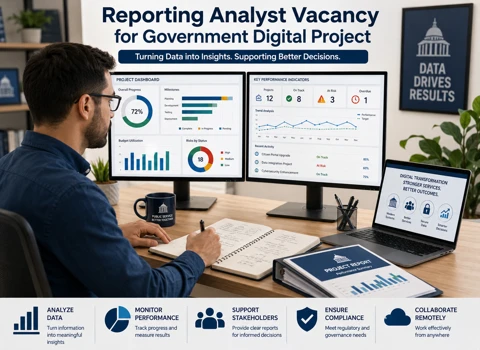
Exploring the Reporting Analyst Vacancy for the Government Digital Project
The Reporting Analyst Vacancy for the Government Digital Project focuses on turning project data into actionable information for leaders. People in this role gather details from different sources, review performance results, and create reports that show how government technology projects are progressing.
As public agencies invest in digital services, cloud platforms, cybersecurity improvements, and modern infrastructure, there is a growing need for professionals who can make sense of large amounts of information. Reporting analysts help ensure that project teams, managers, and government officials have a clear picture of what is happening and where attention may be needed.
For those who enjoy working with facts, spotting patterns, and helping organizations make informed decisions, this position can be both challenging and rewarding.
The Importance of Reporting in Public Sector Technology Projects
Government digital programs often involve multiple departments, external vendors, strict regulations, and significant public funding. Because of this complexity, leaders need reliable reporting to understand whether projects are meeting expectations.
Reporting analysts help provide that clarity. Their reports allow stakeholders to monitor progress, evaluate performance, and address concerns before they become larger problems.
Organizations typically hire reporting analysts to:
- Measure project progress against planned goals
- Monitor key performance indicators
- Support compliance and governance requirements
- Improve visibility across teams and departments
- Highlight risks and performance concerns
- Assist leadership with decision-making
- Maintain consistent reporting practices
Good reporting creates accountability and helps projects stay aligned with their objectives.
Supporting Digital Transformation Across Government
Government modernization efforts can range from improving online services to replacing outdated systems that no longer meet operational needs. These initiatives generate large volumes of data that must be reviewed and interpreted.
The Reporting Analyst Vacancy for the Government Digital Project helps organizations understand whether these investments are producing the desired results.
Projects that often require reporting support include:
- Online citizen service platforms
- Digital permit and licensing systems
- Healthcare technology upgrades
- Transportation modernization programs
- Education technology initiatives
- Cybersecurity improvement projects
- Data management and modernization efforts
By tracking outcomes and measuring performance, reporting analysts help determine whether projects are delivering value to both agencies and the public.
Responsibilities Across Different Project Stages
The work of a reporting analyst changes as projects move from planning to implementation and completion.
Early in a project, analysts may help define reporting requirements and establish performance measures. During implementation, they focus on collecting information, monitoring activity, and producing regular updates. Toward the end of a project, they often contribute to evaluations and lessons-learned reporting.
Typical responsibilities include:
- Gathering information from multiple systems
- Building dashboards and reporting templates
- Producing recurring performance reports
- Monitoring milestones and deadlines
- Tracking budgets and resource usage
- Reviewing data quality
- Supporting audits and compliance activities
- Presenting findings to stakeholders
- Maintaining reporting records
- Comparing results against project objectives
The role often requires close collaboration with project managers, technical specialists, business analysts, and senior leadership teams.
What a Typical Workday Looks Like
No two days are exactly the same, but reporting analysts generally spend much of their time reviewing information, updating reports, and communicating findings.
Common daily tasks include:
- Checking project status updates
- Reviewing data for accuracy
- Updating dashboards
- Analyzing trends and performance indicators
- Attending project meetings
- Preparing summaries for management
- Responding to information requests
- Investigating reporting issues
- Maintaining documentation
- Creating visual presentations
Some days may be dedicated to producing scheduled reports, while others involve deeper analysis or discussions about project performance.
Skills That Help Professionals Excel
Success in this role depends on a combination of technical knowledge and strong communication abilities. Reporting analysts must understand data and be able to explain findings clearly.
Working With Data Effectively
A major part of the job involves reviewing information from different sources and identifying meaningful insights. Analysts need to be comfortable examining data and drawing conclusions based on evidence.
Presenting Information Clearly
Reports are only useful when people can understand them. Reporting analysts must communicate findings in a way that is straightforward and relevant to the audience.
Common reporting formats include:
- Dashboards
- Charts and graphs
- Trend reports
- Performance scorecards
- Executive summaries
Understanding Databases
Knowledge of how information is stored and retrieved can make reporting tasks more efficient and help resolve data-related issues.
Advanced Spreadsheet Skills
Spreadsheets remain a core tool for many reporting functions. Strong skills in formulas, data validation, and automation can improve both accuracy and productivity.
Measuring Performance
Government projects often rely on specific metrics to evaluate success. Analysts need to understand how those metrics are defined, monitored, and interpreted.
Tools Commonly Used in the Profession
The exact software varies by organization, but several platforms are widely used in reporting and analytics roles.
Common tools include:
- Microsoft Excel
- Microsoft Power BI
- Tableau
- SQL databases
- Microsoft Project
- SharePoint
- Oracle reporting applications
- SAP reporting solutions
- Jira
- Confluence
Some government agencies also use custom-built reporting systems designed for their operational requirements.
Experience with business intelligence and data visualization tools is often highly valued by employers.
Education and Professional Qualifications
Most employers look for candidates with a bachelor's degree in a related discipline, although practical experience can sometimes be equally important.
Relevant fields of study include:
- Data Analytics
- Information Systems
- Computer Science
- Statistics
- Business Administration
- Economics
- Public Administration
- Project Management
Hands-on experience with reporting platforms, project environments, and data analysis tools can strengthen a candidate's profile.
Certifications That Can Add Value
Professional certifications are not always required, but they can demonstrate specialized knowledge and commitment to professional growth.
Examples include:
- Microsoft Power BI Certification
- Certified Analytics Professional (CAP)
- Project Management Professional (PMP)
- Certified Business Analysis Professional (CBAP)
- Agile certifications
- Data visualization credentials
These qualifications may help candidates stand out in competitive hiring processes.
Challenges Often Encountered in the Role
Reporting analysts frequently work under deadlines while managing large amounts of information. Accuracy is critical, especially when reports influence important decisions.
Some common challenges include:
- Data inconsistencies between systems
- Missing information
- Evolving reporting requirements
- Diverse stakeholder expectations
- Regulatory obligations
- Complex project structures
- Tight reporting schedules
Strong organizational habits and attention to detail are essential for handling these demands effectively.
Remote Work and Collaboration in Distributed Teams
Many government digital projects now operate with remote or hybrid teams. Since much of the work is performed through digital platforms, reporting analysts can often work effectively from home.
Remote professionals commonly use:
- Microsoft Teams
- Zoom
- Slack
- SharePoint
- Cloud-based reporting tools
- Project management platforms
Working remotely requires self-management, clear communication, and the ability to stay productive without direct supervision throughout the day.
For many professionals, the flexibility associated with a Reporting Analyst Vacancy for the Government Digital Project is one of the role's appealing features.
Who May Enjoy This Type of Work?
Certain qualities tend to align well with reporting and analytics careers.
This role may suit individuals who:
- Enjoy solving problems
- Notice details others might miss
- Like working with data
- Think logically
- Communicate clearly
- Stay organized under pressure
- Adapt to changing technology
- Prefer evidence-based decision-making
People who enjoy transforming raw information into meaningful insights often find satisfaction in this type of work.
Employers That Frequently Recruit Reporting Analysts
Although this position is closely linked to government digital initiatives, similar skills are needed across many industries.
Organizations that commonly hire reporting analysts include:
- Federal agencies
- State and local government departments
- Healthcare providers
- Educational institutions
- Transportation organizations
- Technology consulting firms
- Infrastructure programs
- Nonprofit organizations
- Public sector contractors
Experience gained in government projects can also open doors to opportunities in analytics, business intelligence, and project management.
Future Opportunities and Career Development
The Reporting Analyst Vacancy for the Government Digital Project can be a stepping stone to more advanced analytical and leadership positions. As professionals gain experience, they often take on broader responsibilities and contribute more directly to strategic planning.
Possible career progression includes:
- Senior Reporting Analyst
- Business Intelligence Analyst
- Data Analyst
- Performance Analyst
- Program Analyst
- Project Controls Analyst
- Business Analyst
- Project Manager
- Analytics Manager
- Digital Transformation Manager
As organizations continue to rely on data to guide decisions, professionals with strong reporting and analytical skills remain valuable across both public and private sectors.
With a pay rate of approximately $45 per hour, employers generally seek candidates who can produce accurate reports, maintain data quality, and provide insights that support successful project delivery. For job seekers interested in technology, analytics, and public service, this role offers an opportunity to contribute to projects that improve government operations and citizen services while building highly transferable professional skills.