A doctor mumbles a drug name between patients, and somehow that has to end up correct on paper. Permanently. That's the job. You'd be doing it from home, on your own chair, on your own clock, mostly.
Why This Role Exists
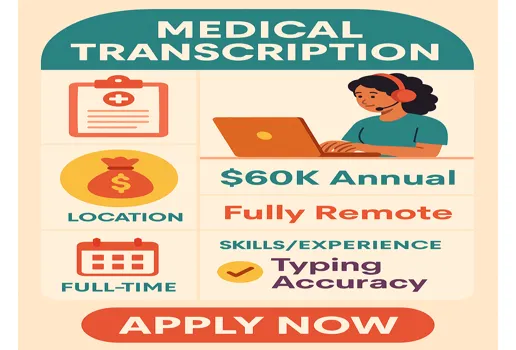
Healthcare runs on paperwork nobody reads until they need it badly. As a Remote Medical Transcription Assistant, you take spoken notes from doctors and clinicians and turn them into records that actually meet compliance standards. Typing fast helps, sure. But getting the meaning right the first time matters more — so whoever reads it later doesn't have to second-guess it. Full-time. 100% remote. Flexible hours. $70,000 a year.
What Fills Your Day
The work itself breaks down into a few recurring pieces:
- Turning voice recordings into clean, grammatically sound written reports
- Working through accents and mumbled dictation without losing accuracy
- Editing for clarity and structure before anything reaches a patient file
- Following formatting standards, even when a file makes that tedious
- Handling HIPAA requirements the way they're meant to be handled, not the shortcut version
- Asking for clarification on unclear dictation instead of guessing your way through it
You'll also rely on AI-assisted transcription tools and cloud-based EHR systems daily, and you'll attend check-ins with physicians, editors, and QA so nothing slips through the cracks.
What Gets You Considered
Minimum education is a high school diploma or equivalent. Beyond that:
- 1 to 2 years in a healthcare or transcription setting
- Real understanding of anatomy, medical terminology, and pharmacology, not just terms you've seen once
- Typing speed of 60+ words per minute without accuracy dropping to hit that number
- Proofreading instincts sharp enough to catch what other people skim past
- Some comfort with Dragon, Express Scribe, Google Workspace, and cloud-based EHR platforms
- Enough self-discipline to run your own workload without hand-holding
Extra Credit
Not required. Helps anyway:
- A certificate in medical transcription or something close to it
- Speaking more than one language
- Specialty experience — cardiology, radiology, psychiatry
- Time spent with tools like ChartNet, Fluency Direct, or encrypted file systems
What Comes With the Job
A few things worth mentioning upfront: remote flexibility that actually fits around your life rather than a fixed shift; a wellness allowance plus help setting up your home workspace; mental health days and your birthday already on the calendar; and a development budget that covers courses and industry conferences.
What the Team Actually Feels Like
Naukri Mitra connected you to this listing, but once you're in, you're working alongside people who treat medical documentation like it's worth doing right, not just finishing. Wins get acknowledged. Check-ins feel real instead of scripted. The team takes the work seriously without making every conversation heavy — feedback lands directly, and ideas actually go somewhere instead of getting nodded at and forgotten.
Does This Sound Like You?
Speed isn't really what separates good candidates here. Noticing when something's off, and caring enough to fix it — that's the thing. If patience and a genuine respect for accuracy come naturally to you, you'll probably do well in this role, even without being the fastest typist in the building.
Next Move
Send your resume with a short note on your transcription or healthcare background. Mention specialties or certifications if you've got them — it helps. Applicants from the USA, Canada, the UK, EU countries, Australia, India, and other eligible regions are welcome, as this role was built to be remote from the start rather than bolted on later.
If careful, clear writing already feels natural to you, this is a decent place to put that to use.