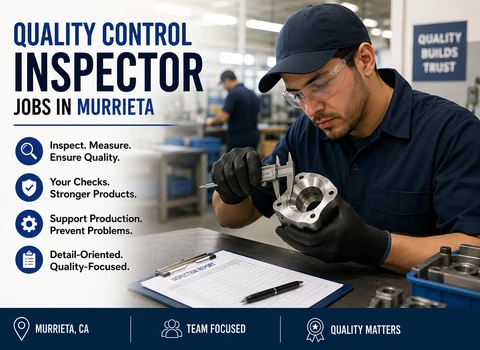
Quality Control Inspector Careers in Murrieta – Keeping Standards Real on the Production Floor
Walk into any production facility, and you’ll notice the pace first—machines running, materials moving, teams focused on keeping everything on schedule. What you don’t immediately see is the person making sure none of that speed compromises quality. That’s where this role comes in.
A Quality Control Inspector works quietly in the background, but the impact is hard to ignore. Every product that passes inspection carries a level of trust, and that trust starts with someone who took the time to double-check, question, and confirm that everything meets the expected standard.
With a yearly salary of $42,000, this role offers steady work for someone who prefers hands-on responsibility over desk-bound routines and who finds satisfaction in getting things right the first time.
Understanding This Role
At its core, this job is about making judgment calls that matter. Not everything is obvious at first glance. Some issues only show up when you take a second look, measure twice, or compare against the right benchmark.
You’re positioned at key points in the manufacturing process—sometimes early, sometimes near the finish line—where your approval determines whether something moves forward or gets pulled back for correction.
There’s a certain level of independence here. You’re trusted to follow standards, but also to recognize when something doesn’t feel right, even if it technically passes a quick check.
Why This Role Matters
Production teams are often focused on output—how much is being made and how quickly. Your role balances that by focusing on whether it’s being made correctly.
Catching an issue early can save hours of rework, reduce material waste, and prevent larger disruptions down the line. More importantly, it protects the end user from receiving a flawed product.
Over time, your consistency contributes to smoother operations. Fewer defects mean fewer interruptions, which helps the entire workflow stay on track without constant corrections.
What Fills Your Workday
No two days are identical, but the structure is familiar. You might begin by checking which batches or components are scheduled for inspection and reviewing any specific quality requirements tied to them.
From there, it’s a mix of observation and measurement. Some parts require precise dimensional checks using tools like calipers or gauges. Others call for visual inspection—looking for surface defects, alignment issues, or inconsistencies in finish.
You’ll spend time recording results in a quality management system, noting anything outside acceptable tolerance levels. When something doesn’t meet standards, you flag it and speak directly with the relevant team. These conversations are usually straightforward and focused on fixing the issue, not assigning blame.
There’s also a steady rhythm to the work. Some periods move quickly when production is high, while others allow for more detailed inspection when production slows.
What Makes You Effective in This Role
This job tends to suit people who don’t rush past details. If you naturally double-check things or notice small inconsistencies, you’ll likely feel comfortable here.
Experience with quality control inspection or manufacturing environments helps, but what really matters is how you approach the work. Patience, focus, and a practical mindset go a long way.
You’ll be using precision measurement tools regularly, so being comfortable handling equipment such as micrometers and gauges is important. Familiarity with defect detection and basic quality assurance processes also eases the learning curve.
Clear communication matters more than people expect. When you spot an issue, explaining it simply and directly helps the team respond faster.
Work Structure and Rhythm
The work follows production cycles, which means your pace is often tied to what’s happening on the floor. When output increases, inspections need to keep up. When things slow down, there’s more room to take a closer look at recurring issues.
You won’t be working in isolation. There’s regular interaction with operators, supervisors, and sometimes maintenance teams when equipment adjustments are needed.
Even with defined procedures, the role still leaves room for judgment. Not every issue fits neatly into a checklist, and part of the job is knowing when something deserves a second look.
Systems You’ll Work With
Most inspections combine hands-on tools with digital tracking. On the physical side, you’ll rely on measurement tools to confirm dimensions and tolerances.
Digitally, you’ll log results into quality management systems that track inspection data and highlight patterns over time. These systems are useful for spotting recurring defects and improving overall production quality.
Documentation is part of the process—not excessive, but enough to ensure there’s a clear record of what was checked and what was found.
What This Work Looks Like in Action
Let’s say a batch of parts comes through that looks fine at first glance. The finish is clean, and nothing appears obviously wrong. But during measurement, you notice that a few samples are slightly off—just enough to raise a concern.
Instead of letting it pass, you check a few more pieces and confirm the pattern. You flag the batch and bring it up with the production team. After a quick review, they discover a minor calibration issue with one of the machines.
The fix is simple, but catching it early prevents a much larger problem. Without that extra attention, the entire batch could have moved forward, causing issues later in assembly or delivery.
Who This Role Is Best Suited For
This role works well for someone who prefers steady, hands-on work over constant multitasking. If you like working with tangible products and seeing the results of your effort in real time, it’s a good fit.
It also suits people who take responsibility seriously. You’re not just checking boxes—you’re making decisions that affect quality, timelines, and customer experience.
Those who remain patient amid repetition and are consistent throughout the day tend to do especially well.
Final Thoughts
Not every role on the production floor is visible, but some are essential in ways that only become clear when something goes wrong. This position helps make sure that doesn’t happen.
Working as a Quality Control Inspector in Murrieta provides practical experience in manufacturing processes, quality assurance, inspection techniques, and precision measurement tools—all skills that remain valuable across industries.
For someone who values careful, reliable work without unnecessary complexity, this role offers both stability and a clear sense of purpose.