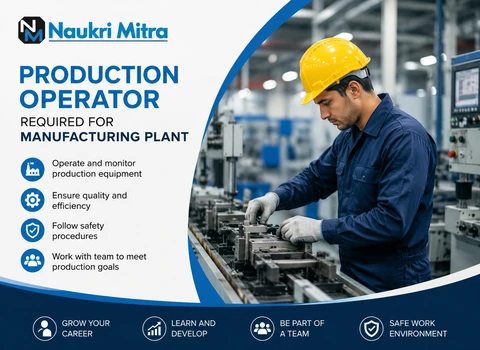
What Does a Production Operator Actually Do All Day?
Walk onto any factory floor, and you'll spot the operator before anyone points them out — they're the one standing near the machine, watching a part come off the line, checking it against a drawing, then loading the next piece without breaking stride. That's the job in a nutshell. This particular opening is for a Production Operator position at a manufacturing plant, a Full-time role based in Hosur, Tamil Nadu, India, and it's worth understanding what the work really involves before applying.
Companies don't hire operators just to press buttons. A machine can run a cycle on its own, sure, but it can't tell you when a tool is wearing down or when a batch is drifting out of tolerance. That judgment comes from the person running it. This is why factories keep investing in trained operators even as automation grows — the machine does the repetition, the operator catches the problems.
A Shift, Start to Finish
Most days begin with a handover from the previous shift. You'll hear what went wrong, what's pending, and what the target is for your shift. After that comes a quick check of the machine — oil levels, tooling, safety guards — before production actually starts.
- Setting the machine as per the job card or production plan
- Loading raw material or components and starting the cycle
- Checking the first few pieces before running the full batch
- Keeping an eye on rejections and stopping the line if something looks off
- Logging production numbers and handing over notes to the next shift
None of this is glamorous. It's repetitive, and on a bad day it can feel like firefighting one small issue after another. But operators who stay sharp through the routine are the ones supervisors trust with harder jobs.
Where the Real Responsibilities Lie
On paper, the job title says operator. In practice, you're also a quality checker, a light maintenance hand, and sometimes a problem-solver when things go sideways mid-shift. Operating the assigned machine is only part of it — reading drawings correctly, following the SOP without shortcuts, and flagging anything unusual to the supervisor matter just as much.
Small preventive tasks fall under this too. Tightening a loose fitting, greasing a moving part, wiping down a machine before it overheats — these aren't in the job description word-for-word, but they're expected.
Which Industries Need This Kind of Work
Auto component manufacturing pulls in a large share of production operators, and Hosur has built a reputation as one of Tamil Nadu's stronger belts for this kind of engineering and precision work. Electrical assembly units, general engineering goods manufacturers, and fabrication shops also hire for similar roles, though the machines and products differ.
The work itself takes place in different settings depending on the company — sometimes in a large manufacturing plant with multiple production lines, sometimes in a smaller machine shop where one operator handles two or three machines at once.
Machines and Instruments You'll Get Familiar With
CNC machines, conventional lathes, hydraulic presses — what you work on depends on the plant. Measuring is a constant part of the job regardless: vernier calipers, micrometers, dial gauges. Get comfortable with these early because half the quality conversations on the floor revolve around whether a measurement fell inside tolerance.
Employers may prefer candidates with relevant machining or tool room training. Depending on the complexity of the work, an ITI in a machining-related trade, a Diploma in Mechanical or Tool and Die Engineering, or equivalent vocational training may be considered suitable. Practical experience with EDM machines, engineering drawings, and precision measuring instruments is often valued as much as formal education.
Skills That Make the Technical Side Easier
Drawing reading is the one skill that keeps coming up. If you can look at a drawing and understand tolerance zones, datum points, and dimensions without someone explaining it every time, you'll pick up new jobs faster than most. SOP knowledge and basic quality documentation round this out.
The Skills Nobody Puts on the Job Card
Showing up on time, every time, matters more in this job than people expect. So does staying alert during the third hour of a repetitive shift, and being willing to ask a question instead of guessing when something's unclear. Teamwork counts too — a shift runs smoother when the operator and the line supervisor are actually talking to each other, not just exchanging a logbook.
The Physical Side of the Job
You're on your feet most of the shift. There's lifting, some bending, standing near equipment that's running, and long stretches where the work doesn't stop for a break in concentration. It suits people who don't mind a physically active routine over a desk job.
This is a Full-time role, and like most manufacturing positions, it typically follows a structured shift pattern — something worth factoring in if you're weighing this against other work.
Safety Isn't Optional Here
PPE is standard on any production floor — safety shoes, gloves, safety glasses, and ear protection in the noisier sections of the plant. None of it is negotiable, and operators who treat it as optional usually learn the hard way why it isn't.
- Machine guards stay on, no exceptions
- Spills get cleaned immediately, not at the end of shift
- Unsafe conditions get reported right away, not ignored
- Interlocks and safety switches are never bypassed to save time
What Trips Up New Operators
Freshers usually struggle with speed in the first few weeks — trying to match the pace of an experienced operator before they've built the muscle memory for it. Rushing at this stage often causes more rejections, not fewer, which is the opposite of what people intend. Breakdowns, shift changes, and tight targets add pressure on top of that learning curve.
What Actually Helps You Get Better at This
Quality builds trust faster than raw speed does. Supervisors notice the operator whose first-piece checks are always right before the ones who finish batches fastest but leave rejections behind. Keep your station organized, ask questions early in training rather than after a mistake, and check the first few pieces of every new batch properly instead of rushing past that step.
Where This Role Can Lead
Operators who stick with it and keep learning usually move toward senior operator or shift-in-charge positions, sometimes into quality checking, and eventually into machine setter or supervisor roles. Gaining knowledge of newer machines and quality systems along the way tends to speed up this progression.
Pay and What Usually Comes With It
This Production Operator position in Hosur, Tamil Nadu, India pays ₹27,000 a month. Beyond the base salary, manufacturing roles like this one often come with additional benefits — overtime pay, PF, ESI, a performance bonus, uniforms, transport, or canteen facilities — though what's actually offered depends on the individual company's policy.
For freshers, ITI candidates, diploma holders, and experienced technical workers alike, this Full-time opening is a reasonably practical entry into manufacturing work in one of Tamil Nadu's established industrial regions.