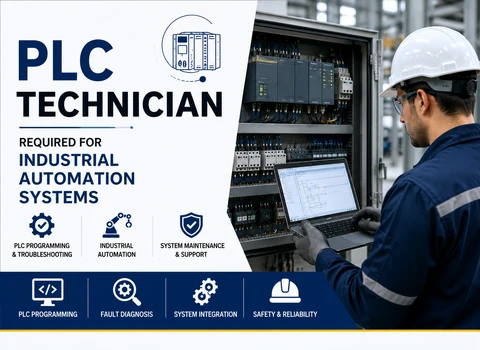
What Actually Happens Behind an Automated Production Line
Walk into most factories around Pune today, and you'll notice something: very few workers are pushing buttons by hand anymore. Machines start, stop, and adjust themselves based on programmed instructions. Someone has to keep that programming alive and working, and that someone is usually a
PLC Technician. This is a full-time opening based in Pune, Maharashtra, and it suits people who want to build a career around industrial control systems rather than treat it as a stopgap job.
If you're new to this field, here's the simplest way to picture it. A PLC (Programmable Logic Controller) acts like the decision-making brain inside a machine. Sensors feed it information, the logic inside decides what should happen next, and the PLC sends out commands to motors, valves, or actuators accordingly. The technician's job is to keep that brain healthy — and step in fast when it isn't.
Why This Job Exists at All
Automation reduces manual labor, but it also adds a layer of electrical and electronic complexity that wasn't there before. A machine that used to be operated purely by hand now depends on wiring, sensors, and code, all of which can fail in ways an untrained eye won't catch. When a line goes down because of a faulty input module or a wiring fault, production stops — and stopped production costs money fast. That's the core reason manufacturing units keep hiring for this position rather than leaving it vacant.
What the Shift Actually Looks Like
Mornings usually start with a walk across the shop floor, checking panels and looking for fault lights or error messages nobody's addressed yet. From there it gets less predictable. Some days it's a loose terminal connection that takes ten minutes to fix. Other days a machine throws an error that traces back to a logic sequence buried in the program, and that can eat up hours.
A technician typically ends up doing some combination of the following through the day:
- Checking PLC panels and HMI screens for alarms
- Testing wiring, relays, and input-output cards with a multimeter
- Connecting a laptop to run diagnostics on the control program
- Talking to machine operators to understand what went wrong before the breakdown
- Getting a stalled machine back online, then documenting what caused it
No single day repeats itself exactly, which is part of what keeps the work interesting for people who don't like routine desk tasks.
Beyond Fixing What's Broken
Troubleshooting gets most of the attention, but it isn't the whole job. Technicians also tweak and update ladder logic programs when processes change, calibrate sensors to keep readings accurate, and follow preventive maintenance checklists to catch problems before they turn into breakdowns. None of this happens in isolation either — electricians and mechanical maintenance staff are usually working the same floor, and faults often turn out to be a mix of electrical, mechanical, and programming issues tangled together.
Where This Work Actually Happens
You'll find this role in automobile component manufacturing, packaging units, food processing plants, plastic and injection molding factories, and general engineering workshops. Physically, that could mean standing near heavy machinery on an open shop floor, or working inside a control room lined with panels — often it's a mix of both, depending on how the plant is laid out.
The Equipment You'll Actually Touch
PLC brands vary by plant — Siemens, Allen-Bradley, Mitsubishi, and Delta all show up depending on what the factory has installed over the years. Alongside the PLC itself, technicians work with HMI touch panels for operator interfaces, multimeters and clamp meters for electrical checks, programming software to edit ladder logic, and a basic set of hand tools for panel wiring. Knowing your way around VFDs (Variable Frequency Drives) and servo drives isn't always required on day one, but it helps a lot once you're handling more complex lines.
Skills That Actually Matter on the Floor
Technical knowledge only goes so far without the ability to apply it under pressure. What tends to separate a strong candidate from an average one:
- Reading electrical and control panel drawings without hand-holding
- A working grasp of ladder logic, not just theory from a textbook
- Solid knowledge of sensors, motors, and industrial wiring standards
- Comfort handling precision measuring instruments
- The patience to trace a fault logically instead of guessing
Most employers look for an ITI in Electrical, Electronics, or Instrumentation, or a Diploma in Electrical/Electronics Engineering. That said, freshers with strong hands-on training during their course often get a fair shot, while experienced technicians with real plant exposure are considered for the trickier machines — it depends on how complex the equipment is.
Physically, What's Expected
Expect to be on your feet for long stretches, walking the floor, and occasionally working in cramped panel spaces where cable runs aren't exactly generous. Since most plants operate on shifts, being open to rotational shift times is usually part of the deal.
Safety Isn't Optional Here
Electrical maintenance work carries real risk, so safety practices aren't just a formality. Safety shoes, insulated gloves, and safety goggles are standard PPE. Before opening a live panel, lockout/tagout procedures are followed — this single habit prevents most serious electrical accidents in maintenance work.
Where New Technicians Tend to Struggle
Unfamiliar PLC brands trip people up more often than anything else, especially when the wiring documentation is outdated or missing altogether. One habit that helps is keeping a personal log of recurring faults and how they were fixed. It sounds basic, but it cuts troubleshooting time dramatically after a few months, and asking senior technicians questions during quiet stretches speeds things up even further.
How the Career Tends to Progress
Technicians who stick with the field and keep learning usually move toward senior technician roles, automation maintenance supervisor positions, or more specialized programming work — all within the same automation track rather than a completely different profession.
Pay and What Else Might Come With It
This is a full-time role based in Pune, Maharashtra, India, with a monthly salary of ₹36,000. Depending on the employer, you might also see overtime pay, PF, ESI, bonuses, uniforms, or transport and canteen facilities — these vary by company and aren't guaranteed across the board.