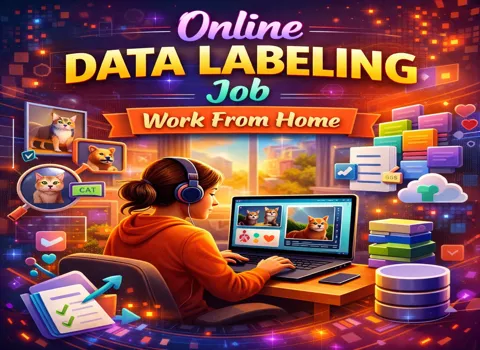
Remote Online Data Labeling Opportunity – Work From Home Career
Some jobs are loud. This one isn’t.
It doesn’t come with constant calls, endless meetings, or pressure to be “on” all the time. Instead, it’s the kind of work that happens quietly in the background—yet plays a real role in how modern technology functions.
Every time an app feels intuitive, or a system understands what someone meant to say, there’s structured data behind it. And before that structure exists, someone has to create it.
That’s where this role fits in.
With a yearly salary of $50,000 and the ability to
work from home, this position offers a steady, focused way to earn while contributing to something that actually gets used.
Role Overview
At a glance, the work is simple: look at the content and label it correctly.
In practice, it’s more nuanced than that.
You might be reviewing images, sorting text, or listening to short audio clips. The goal is always the same—apply the right label based on a clear set of instructions. Over time, those small decisions build into datasets that machines learn from.
There’s no guesswork involved. When something feels unclear, the guidelines are there to help. The work rewards people who slow down, pay attention, and stick to the process.
What This Role Contributes
It’s easy to underestimate work like this because the output isn’t flashy. But without clean, well-labeled data, machine learning systems struggle.
Each correct label helps:
- Improve how AI models interpret information
- Make digital tools more accurate for users
- Reduce confusion in automated systems
- Support teams working on large-scale data projects
The impact builds over time. One decision might not feel like much—but thousands of consistent decisions change how a system performs.
Day-to-Day Work
The day usually starts with logging in to a platform where tasks are assigned. From there, it’s about working through batches of content.
Some tasks are quick and straightforward. Others take a bit more thought.
You could be:
- Identifying objects or scenes in images
- Grouping written content by meaning or tone
- Reviewing short audio clips and tagging key details
- Checking someone else’s work to make sure it meets quality standards
There’s repetition, yes—but not the kind that feels mindless. The context changes just enough to keep your attention engaged.
Skills That Help You Succeed
This isn’t a role where being the fastest person in the room matters.
What helps more is being steady.
People who tend to do well here usually:
- Catch small inconsistencies others overlook
- Stay patient when tasks repeat
- Follow instructions closely without skipping steps
- Work comfortably on their own
- Keep a consistent pace without burning out
No advanced technical background is required. The learning curve is manageable if you’re willing to stay focused.
How Work Happens in This Remote Role
Everything runs online. Tasks appear in the system, progress updates are sent automatically, and feedback comes through the same channel.
There’s no fixed office setup, which means you can shape your workday around your own routine. Some people prefer early mornings. Others settle into a rhythm later in the day.
That flexibility helps—but it also means you need to manage your own time. Without structure, it’s easy to drift. The people who do well here tend to build a routine and stick to it.
Tools or Methods Used in the Work
The tools are built to guide you, not overwhelm you.
You’ll spend most of your time inside:
- Data annotation platforms where labeling happens
- Quality review systems that flag inconsistencies
- Task dashboards that show progress and deadlines
- Structured datasets used for machine learning projects
Most of it becomes familiar quickly. You learn by doing, not by memorizing.
A Realistic Scenario from the Workday
Let’s say you’re working on a batch of product images.
Most are easy—clear, well-lit, and obvious. Then one shows up that doesn’t quite fit. It could belong in two different categories.
You pause.
Instead of rushing, you check the guidelines, compare similar cases, and choose the most accurate option. It takes a little longer, but it’s the right call.
Multiply that moment by hundreds of decisions across a project, and the difference becomes noticeable. Search results improve. Filters work better. Users find what they need faster.
That’s the kind of impact this work has.
Who Thrives in This Role
Not everyone enjoys this kind of work—and that’s okay.
It tends to suit people who:
- Like working independently without constant interaction
- Prefer clear, structured tasks over open-ended work
- Don’t mind repetition when it has a purpose
- Feel satisfied getting details right
- Want a stable remote role without unnecessary complexity
If you need constant variety or fast-paced teamwork, this might feel too quiet. But for the right person, that quiet is exactly the benefit.
Closing Message
There’s a lot of focus today on big, visible roles in tech. But the systems people rely on every day don’t run on visibility—they run on consistency.
This role is part of that foundation.
It offers steady work, a clear process, and the chance to contribute to something that improves over time. No noise, no pressure to perform for an audience—just focused work that adds up to something meaningful.
For someone who values that kind of environment, it can be a surprisingly good fit.