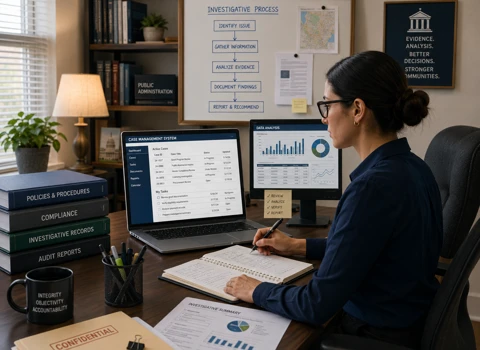
Exploring the Career of a Research Investigator for Government Operations
A Research Investigator for Government Operations examines information, reviews records, and analyzes evidence to help government agencies make informed choices. The role sits at the intersection of research, oversight, compliance, and public administration. Professionals in this field are responsible for uncovering facts, evaluating information, and presenting findings that support government programs and operational decisions.
Government agencies oversee everything from public assistance and transportation systems to licensing, grants, regulatory enforcement, and community services. Because these activities directly affect citizens, decisions must be based on reliable information. Research Investigators help provide that reliability by examining records, identifying concerns, and documenting findings in a clear and objective way.
Many organizations now offer remote positions for qualified professionals. Secure technology enables investigators to access records, collaborate with colleagues, and complete assignments from home while adhering to strict confidentiality and security requirements.
Salary: $1,750 per week
Why Government Agencies Rely on Research Investigators
Public agencies are expected to operate responsibly, comply with regulations, and use taxpayer resources appropriately. To support those goals, they often depend on Research Investigators to verify information and assess operational activities.
A Research Investigator for Government Operations may be involved in:
- Reviewing records and supporting documents
- Examining operational issues
- Looking into complaints or reported concerns
- Assisting with audits and compliance reviews
- Measuring program performance
- Verifying data accuracy
- Preparing reports and investigative summaries
The information gathered through these efforts helps agencies improve processes, identify risks, and make evidence-based decisions.
Turning Information Into Actionable Findings
One of the most important aspects of this profession is the ability to make sense of large amounts of information. Government leaders often need clear answers before taking action.
Questions investigators may help address include:
- Are procedures being followed correctly?
- Does the available evidence support a particular claim?
- Are public funds being used appropriately?
- Where are operational weaknesses occurring?
- Is a government program meeting its objectives?
Research Investigators gather facts, evaluate evidence, and organize their conclusions into reports that help decision-makers understand complex situations. Their responsibility is to provide objective analysis rather than advocate for a specific outcome.
What the Work Often Looks Like Day to Day
The exact duties vary by agency and assignment, but most Research Investigators spend much of their time reviewing information, conducting research, and documenting findings.
Typical activities include:
- Examining case files and agency records
- Searching databases and public sources
- Comparing information across systems
- Conducting online research
- Identifying unusual patterns or discrepancies
- Writing reports and summaries
- Attending virtual meetings
- Monitoring project timelines
- Maintaining organized records
Some projects are completed independently, while others involve close coordination with auditors, attorneys, compliance specialists, program managers, or agency leadership.
An Example of a Real-World Investigation
Imagine a government agency notices irregular activity within a grant program. A Research Investigator may be asked to determine whether the issue resulted from administrative errors, misunderstandings of policy, or potential misuse of funds.
The investigation could involve:
- Reviewing grant applications
- Examining supporting documentation
- Comparing records across databases
- Confirming eligibility requirements
- Analyzing payment histories
- Recording any inconsistencies
The final report provides agency leaders with information to determine the next steps.
Methods Commonly Used During Investigations
Research Investigators follow structured processes designed to ensure accuracy and consistency. Their conclusions must be supported by evidence and capable of standing up to review.
Common investigative techniques include:
- Reviewing documents and records
- Verifying information
- Conducting compliance assessments
- Analyzing data
- Evaluating policies
- Identifying trends
- Collecting evidence
- Validating sources
Even small discrepancies can reveal larger operational concerns, making careful analysis essential.
Sources of Information Frequently Examined
Professionals in this role often work with a variety of information sources, including:
- Public records
- Internal databases
- Financial documents
- Regulatory guidance
- Legislative materials
- Historical case files
- Program participation records
- Administrative documentation
Knowing how to locate reliable information and assess its credibility is a core part of the profession.
Abilities That Support Success in the Role
People considering this career often ask what skills are most valuable. Successful Research Investigators typically combine analytical thinking with strong communication and organizational abilities.
Analytical Thinking
Investigators regularly review large volumes of information and must recognize patterns, inconsistencies, and relationships that others may overlook.
Effective Writing
Reports are often reviewed by managers, auditors, attorneys, and policymakers. Clear writing helps ensure findings are understood and applied correctly.
Sound Judgment
Not every source of information is equally reliable. Investigators must evaluate evidence carefully and determine which information can be trusted.
Organizational Skills
Investigations often involve extensive documentation. Maintaining organized records helps support accuracy and efficient case management.
Communication Skills
Gathering information may require discussions with agency staff, stakeholders, or subject-matter experts. Strong communication helps facilitate productive exchanges.
Attention to Detail
Many investigations involve complex records and lengthy reviews. Careful attention helps ensure important details are not missed.
Educational Backgrounds Often Seen in the Field
There is no single educational route into this profession. Employers generally look for candidates whose studies have emphasized research, analysis, administration, policy, or investigative work.
Common degree areas include:
- Public Administration
- Criminal Justice
- Political Science
- Sociology
- Economics
- Business Administration
- Public Policy
- Information Management
Experience in auditing, compliance, investigations, regulatory affairs, or government operations can also be highly valuable.
Certifications That May Add Value
Although certifications are not always required, they can demonstrate specialized knowledge and professional commitment.
Examples include:
- Certified Fraud Examiner (CFE)
- Certified Compliance and Ethics Professional (CCEP)
- Certified Government Auditing Professional (CGAP)
- Project Management Professional (PMP)
- Data Analytics Certifications
- Risk Management Certifications
The usefulness of a certification often depends on the agency's mission and the type of work being performed.
Technology and Software Used in the Profession
Modern government investigations rely heavily on digital tools. Whether
working remotely or in an office, investigators use technology to manage information, analyze records, and communicate securely.
Common systems include:
- Case management platforms
- Records management software
- Data analytics tools
- Secure communication applications
- Collaboration platforms
- Document management systems
- Reporting software
Technical Skills Employers Frequently Seek
Experience with the following tools is often beneficial:
- Microsoft Excel
- Microsoft Word
- Microsoft Teams
- SharePoint
- Power BI
- SQL databases
- Case tracking software
- Government information systems
Comfort with technology helps investigators handle complex assignments more efficiently.
Challenges That Come With Investigative Work
Like many analytical professions, this role presents challenges that require patience, objectivity, and persistence.
Common difficulties include:
- Incomplete records
- Tight deadlines
- Complex regulations
- Large volumes of data
- Conflicting information
- Frequent policy updates
- Sensitive documentation
Investigators must remain methodical even when information is difficult to interpret or scattered across multiple sources.
Managing Sensitive Information Responsibly
Research Investigators often work with confidential government records. Protecting that information is a critical part of the job.
Responsibilities may include following procedures related to:
- Data security
- Privacy regulations
- Record retention requirements
- Secure document handling
- Access controls
Government agencies place significant trust in investigators to safeguard sensitive information and maintain professional standards.
Remote Opportunities in Government Research
Many responsibilities associated with a Research Investigator for Government Operations can be performed remotely. Since records, communication tools, and reporting systems are largely digital, remote work has become increasingly common.
Remote investigators often:
- Access secure databases
- Conduct online research
- Participate in virtual meetings
- Prepare electronic reports
- Collaborate with colleagues across locations
Success in a remote environment often depends on strong time management, organization, and self-discipline.
Security Expectations for Remote Employees
Government agencies typically enforce strict cybersecurity standards for remote workers.
These measures may include:
- Multi-factor authentication
- Encrypted connections
- Secure file storage
- Restricted access permissions
- Confidentiality agreements
- Compliance with agency security policies
These safeguards help protect sensitive information and maintain public confidence.
Where Research Investigators Commonly Work
Most positions are found within government agencies, although organizations that support public-sector operations may also hire professionals with similar expertise.
Potential employers include:
- Federal agencies
- State government departments
- Local government offices
- Regulatory bodies
- Public health organizations
- Transportation authorities
- Education departments
- Public utility organizations
- Government contractors
- Oversight and compliance offices
While responsibilities vary by organization, the investigative and analytical foundations of the role remain consistent.
Is This Career a Good Match for You?
This profession often attracts individuals who enjoy solving problems through research and evidence-based analysis.
People who perform well in the role often possess:
- Natural curiosity
- Strong attention to detail
- Ethical decision-making skills
- Independent work habits
- Analytical thinking abilities
- Effective written communication
- Interest in public service
- Comfort working with regulations and policies
Those who enjoy uncovering facts, evaluating evidence, and reaching logical conclusions often find the work both engaging and rewarding.
Advancement Opportunities and Long-Term Growth
Experience as a Research Investigator for Government Operations can lead to a variety of career opportunities within government and related industries.
Potential advancement paths include:
- Senior Research Investigator
- Compliance Officer
- Government Auditor
- Program Analyst
- Policy Analyst
- Investigations Manager
- Regulatory Affairs Specialist
- Risk Management Analyst
- Operations Manager
- Government Program Director
As professionals gain experience, they may take on larger investigations, supervise teams, oversee programs, or contribute to strategic planning efforts.
Continuing education, specialized certifications, and expertise in areas such as compliance, auditing, public policy, or data analytics can create additional opportunities for advancement.
For individuals interested in research, critical thinking, and public accountability, the Research Investigator for Government Operations role offers a meaningful career path that combines investigative work with the opportunity to support effective government services.