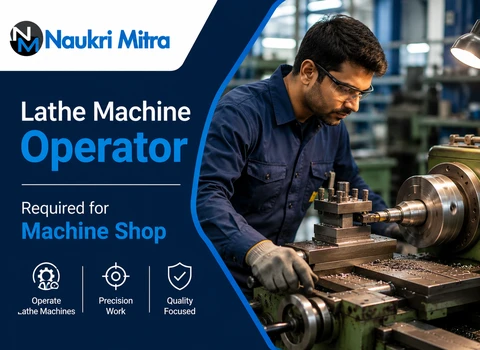
What Does a Lathe Machine Operator Actually Do?
Picture a rod of raw metal spinning at high speed while a cutting tool slowly shaves it into shape. That's turning, and it's the job at the center of this role. A lathe machine operator takes rough stock — steel, brass, aluminum, whatever the order calls for — and cuts it down to the exact size written on the drawing. Get it wrong by even half a millimeter, and the part often can't be used.
The Demand Behind This Role in Rajkot
Gujarat has one of the busiest small-scale manufacturing belts in India, and Rajkot sits right in the middle of it. Casting units, auto parts makers, pump manufacturers, and diesel engine workshops all need turned components regularly. Not every part can be made on a CNC machine cost-effectively — small batches, custom jobs, and one-off repairs still go to a conventional lathe. That's exactly why machine shops keep hiring operators who can run one confidently.
Walking Through a Regular Shift
The day starts with a job card. Sometimes it's a fresh order; sometimes it's a repeat batch the shop has run before. Either way, the operator studies the drawing, picks the right tool, and clamps the material into the chuck. A test piece comes first — nobody runs a full batch blind. Once the dimensions check out on the first piece, production begins, but the checking never really stops. Every few pieces, the operator picks up a caliper again, just to be sure the tool hasn't worn down or the setting hasn't drifted.
What the Job Actually Involves
- Reading engineering drawings and tolerance charts
- Setting spindle speed and feed rate based on the material
- Clamping and centering workpieces correctly before cutting
- Carrying out turning, facing, threading, boring, and taper work
- Measuring finished parts and rejecting anything out of spec
- Flagging worn tools or unusual machine sounds before they cause damage
- Keeping basic production and rejection counts updated
Where This Kind of Work Happens
Most operators end up in machine shops, tool rooms, or job-work units that take on custom orders from bigger companies. A few work inside larger factories where turning is just one stage in a longer assembly process. None of these places are quiet. Expect the smell of cutting coolant, the constant hum of running machines, and metal shavings that need to be cleared every so often. If you're someone who prefers a desk, this isn't the trade for you — but if hands-on work suits you, the shop floor becomes familiar territory fast.
Machines and Instruments You'll Get Used To
Conventional lathes are still the backbone of most small shops, though larger ones are adding CNC lathes for repeat, high-precision jobs. On the tooling side, operators handle single-point cutting tools, boring bars, and thread-cutting tools. Measurement is where precision is actually confirmed — vernier calipers and micrometers for everyday checks, dial gauges for runout, and height gauges when a job demands them.
Training That Actually Matters Here
Employers may prefer candidates with relevant machining or tool room training. Depending on the complexity of the work, an ITI in a machining-related trade, a Diploma in Mechanical or Tool and Die Engineering, or equivalent vocational training may be considered suitable. That said, paper qualifications only go so far. Practical experience with EDM machines, engineering drawings, and precision measuring instruments is often valued just as much — sometimes more — because a lathe teaches things a classroom simply can't.
The Skills That Separate Good Operators From Average Ones
Ask any experienced operator and they'll tell you the machine talks — through sound, through vibration, through the way the chip curls off the tool. Learning to read those signals takes time. A good operator notices a slight change in pitch and knows the tool is going dull before the part comes out wrong. That kind of instinct isn't taught directly; it builds up over months on the floor, usually through mistakes as much as successes.
The Physical Side of the Job
This is standing work. Long hours on your feet, repeated bending to load and unload material, and hands that stay busy through most of the shift. Shift work may apply depending on the workshop's schedule, and this is a full-time role based in Rajkot, Gujarat, India. Stamina matters, but so does staying alert — a tired operator is far more likely to miss a measurement error or misjudge a cut.
Safety Habits Around a Spinning Chuck
A rotating chuck doesn't forgive carelessness. Loose sleeves, dangling chains, or a moment of distraction near the machine can cause serious injury, which is why safety goggles, work-appropriate gloves, closed shoes, and ear protection in noisy sections are standard PPE on most shop floors. Machines are never left running unattended, and clothing that could get caught is avoided entirely near the working area.
Where New Operators Usually Struggle
Consistency is the hardest part to learn. Early on, most operators can hit the right dimension once but struggle to repeat it across a full batch. Tool wear catches people off guard too — a cut that looked fine ten pieces ago can quietly go out of tolerance. The fix isn't complicated: slow down, measure more often than feels necessary, and watch how the experienced hands on the shop floor adjust their approach mid-job.
Where This Trade Can Lead
Operators who stick with the trade don't usually stay in the same spot for long. Some move into CNC programming once they understand conventional machining well. Others shift toward quality inspection, checking other people's work instead of doing the cutting themselves. A fair number end up supervising newer operators or handling the shop's trickiest, highest-precision jobs — the ones nobody hands to a beginner.
Pay and What Else Might Come With It
This full-time position pays ₹24,500 a month. On top of that, some workshops offer overtime pay, PF, ESI, bonus, uniforms, or transport and canteen facilities — though none of this is guaranteed across every employer, and it's worth confirming directly with the workshop before joining.