Inside the Role of a Community Researcher Supporting Government Outreach
A
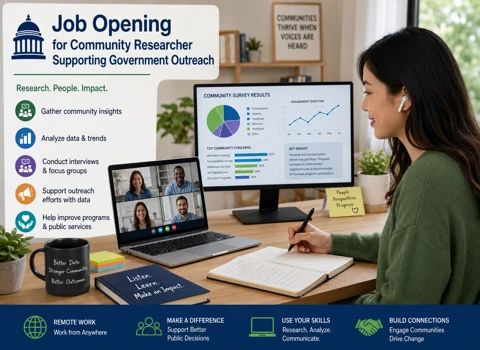
Community Researcher Supporting Government Outreach helps public organizations understand the people they serve. The work sits at the intersection of research, communication, and community engagement. Rather than making policy decisions directly, these professionals gather information that helps government teams design better programs, improve outreach efforts, and respond to local concerns more effectively.
Many agencies and organizations rely on community researchers because decisions are stronger when they are informed by real-world experiences. Whether the topic is housing access, transportation, healthcare services, education programs, or workforce initiatives, understanding community perspectives is essential.
This role is especially attractive to people who enjoy asking questions, analyzing information, and working on projects that have a visible impact on communities. Because much of the work can be completed online, remote opportunities have become increasingly common.
Why Government Outreach Teams Depend on Community Research
Government programs often serve large and diverse populations. Without reliable feedback, it can be difficult to know whether services are reaching the right people or solving the intended problems.
A Community Researcher Supporting Government Outreach helps uncover answers to questions such as:
- What challenges are residents experiencing?
- Are outreach campaigns reaching target audiences?
- Which services are underused and why?
- What barriers prevent participation?
- How do different groups view government initiatives?
The information collected through research helps agencies make informed decisions instead of relying on assumptions. In many cases, research findings influence communication strategies, program improvements, and future planning efforts.
What the Work Looks Like From Day to Day
No two projects are exactly alike. One week may focus heavily on data analysis, while another may involve interviews and stakeholder discussions.
Common responsibilities include:
- Reviewing survey responses
- Conducting virtual interviews
- Gathering demographic information
- Tracking community engagement metrics
- Summarizing research findings
- Preparing reports and presentations
- Supporting outreach campaigns with data insights
- Coordinating online focus groups
- Monitoring public feedback channels
For example, a researcher might spend the morning analyzing survey results from a transportation study and the afternoon meeting virtually with outreach coordinators to discuss emerging trends.
Because projects often involve multiple departments and community partners, staying organized is a major part of the job.
Gathering Information That Reflects Real Community Experiences
Research in this field generally falls into two categories: quantitative and qualitative.
Working With Numbers and Measurable Data
Quantitative research focuses on information that can be counted, measured, and compared.
Examples include:
- Survey statistics
- Participation rates
- Census data
- Demographic trends
- Program enrollment figures
This type of research helps identify patterns across larger populations and provides measurable evidence for decision-makers.
Learning Through Conversations and Feedback
Qualitative research explores experiences, opinions, and perspectives.
Researchers may collect this information through:
- One-on-one interviews
- Focus groups
- Community listening sessions
- Open-ended questionnaires
- Stakeholder discussions
These methods often reveal details that numbers alone cannot explain. For instance, survey data may show low participation in a program, while interviews reveal the reasons behind that trend.
Professionals who can interpret both forms of research are often highly valued.
Building Trust Through Effective Communication
Strong communication skills are central to success in this profession. People are often more willing to provide candid and meaningful feedback when they feel heard, respected, and valued.
Important abilities include:
- Active listening
- Clear written communication
- Interview techniques
- Public engagement skills
- Presentation development
- Cultural awareness
- Professional relationship building
Researchers frequently interact with people from different backgrounds and communities. The ability to communicate without bias and create a comfortable environment for discussion is essential.
Good communication also helps when presenting findings to government officials, project managers, and outreach teams.
Technology and Research Platforms Used in Remote Roles
Most remote Community Researcher Supporting Government Outreach positions rely heavily on digital tools.
Frequently used software includes:
- Microsoft Excel
- Google Sheets
- Microsoft Teams
- Zoom
- Google Workspace
- SurveyMonkey
- Qualtrics
- Google Forms
- Airtable
- Tableau
- Power BI
Researchers use these platforms to collect information, organize datasets, conduct virtual meetings, and create reports.
Data visualization tools are particularly useful because they help transform complex findings into charts and graphics that stakeholders can quickly understand.
Educational Paths That Can Lead to This Career
There is no single degree required for becoming a Community Researcher Supporting Government Outreach. Employers typically look for candidates who have developed research, analytical, and communication skills through education or professional experience.
Common academic backgrounds include:
- Sociology
- Political Science
- Public Administration
- Public Policy
- Communications
- Anthropology
- Economics
- Urban Planning
- Community Development
- Social Work
Candidates with practical experience in outreach, nonprofit work, public service, or research projects may also qualify, even if their degree is in a different field.
Additional Training That Can Be Helpful
Although certifications are rarely mandatory, they can strengthen a resume and demonstrate specialized knowledge.
Useful credentials may include:
- Research methodology training
- Data analytics certificates
- Community engagement programs
- Survey design courses
- Project management certifications
- Public policy workshops
Ongoing learning is common in this field because research methods and technology continue to evolve.
Challenges You May Encounter in the Position
Community research can be rewarding, but it is not always straightforward.
Some common obstacles include:
- Low response rates to surveys
- Difficulty reaching certain populations
- Tight reporting deadlines
- Sensitive community concerns
- Incomplete datasets
- Conflicting stakeholder priorities
- Changes in government programs or funding
For example, residents may be reluctant to participate in research if they feel previous feedback was ignored. In these situations, researchers must work carefully to build credibility and encourage meaningful participation.
Patience and adaptability often make a significant difference when navigating these challenges.
What Remote Work Is Really Like in This Profession
Many organizations now hire remote researchers because much of the work can be completed online. Surveys, interviews, meetings, and data analysis can all be managed through digital platforms.
Benefits of
remote work often include:
- Greater flexibility
- Reduced commuting expenses
- Access to opportunities outside local markets
- More focused research time
- Improved scheduling options
At the same time, remote professionals must be comfortable managing their own workload and maintaining productivity without constant supervision.
Success in a remote environment often depends on:
- Time management
- Self-motivation
- Strong written communication
- Attention to deadlines
- Secure handling of sensitive information
Researchers who stay organized and proactive generally adapt well to remote settings.
Where Community Researchers Commonly Find Employment
The skills developed in community research are useful across many sectors.
Organizations that frequently hire for these roles include:
- Government departments
- Public policy organizations
- Research institutes
- Consulting firms
- Nonprofit agencies
- Educational institutions
- Healthcare organizations
- Housing authorities
- Community development groups
- Advocacy organizations
Projects can vary widely. One assignment may focus on public health outreach, while another examines transportation access or workforce development programs.
This variety keeps the work interesting and allows professionals to build expertise across multiple subject areas.
Personal Qualities That Fit the Profession
While technical skills are important, certain personal characteristics often help people succeed in community research.
Strong candidates are typically:
- Curious about social issues
- Detail-focused
- Empathetic
- Analytical
- Organized
- Adaptable
- Reliable
- Comfortable working independently
- Interested in public service
- Skilled at problem-solving
People who enjoy understanding how communities function and how public programs affect everyday life often find this work meaningful.
The role requires balancing objective analysis with genuine respect for the people whose experiences are being studied.
Growth Opportunities Beyond Entry-Level Research
Experience as a Community Researcher Supporting Government Outreach can open doors to a variety of advanced positions.
Potential career progression may include:
- Senior Research Analyst
- Community Engagement Manager
- Outreach Program Manager
- Public Policy Analyst
- Government Relations Specialist
- Research Project Manager
- Program Evaluation Specialist
- Social Impact Consultant
- Director of Community Engagement
As professionals gain experience managing projects, interpreting data, and working with stakeholders, they often take on greater responsibility and leadership duties.
Many employers also support professional development through workshops, conferences, specialized training programs, and continuing education opportunities.
Making an Impact Through Community-Focused Research
A
Community Researcher Supporting Government Outreach plays a valuable role in helping organizations understand public needs and improve community engagement efforts. The position combines research, communication, analysis, and collaboration to directly support informed decision-making.
For individuals who enjoy investigating issues, working with data, and contributing to projects that affect real communities, this career offers meaningful work and long-term growth potential. The remote nature of many positions also provides flexibility while allowing researchers to contribute to important public initiatives from virtually anywhere.
Position Type: Remote
Compensation: $1,500 per week
Professionals who thrive in this field are often those who enjoy turning community feedback into practical insights that help organizations serve people more effectively.