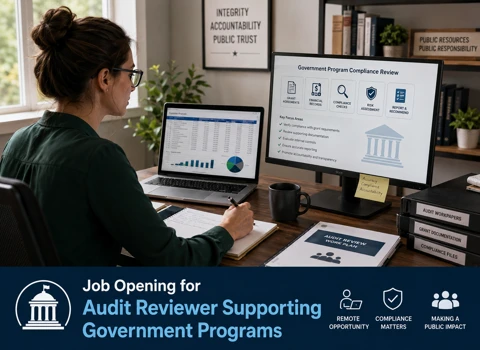
Exploring a Career as an Audit Reviewer Supporting Government Programs
Government-funded programs are expected to manage public money responsibly and follow strict rules regarding how funds are spent. An
Audit Reviewer Supporting Government Programs helps ensure those expectations are met by examining financial records, reviewing supporting documentation, and checking compliance with grants, contracts, and regulatory standards.
This
remote role pays
$42 per hour and is often a good match for professionals with experience in auditing, accounting, compliance, finance, or program administration. Beyond reviewing numbers and reports, the position contributes to accountability and helps organizations demonstrate that public resources are being managed appropriately.
People who enjoy investigating details, analyzing records, and identifying inconsistencies often find this type of work both intellectually stimulating and professionally rewarding.
The Importance of Audit Review in Publicly Funded Programs
Organizations that receive government funding are required to maintain accurate records and follow detailed reporting requirements. Whether the funding supports healthcare services, educational initiatives, housing programs, or community projects, oversight is essential.
An Audit Reviewer Supporting Government Programs helps verify that organizations are meeting those obligations. Through careful examination of financial activity and operational records, these professionals help reduce risk and support compliance efforts.
Organizations rely on audit reviewers to:
- Identify errors and reporting issues
- Verify compliance with grant and contract requirements
- Evaluate internal controls
- Reduce financial and regulatory risks
- Improve the accuracy of financial reporting
- Support transparency and accountability
- Prepare for external audits and reviews
Their work often helps organizations address concerns before they become larger compliance problems.
Supporting Accountability for Government Resources
Public funding reaches many different industries and service areas. Each program may have its own regulations, reporting schedules, and documentation requirements.
Audit reviewers may work with programs related to:
- Healthcare and public health services
- Education and training initiatives
- Affordable housing projects
- Transportation and infrastructure programs
- Workforce development efforts
- Environmental and conservation programs
- Community assistance services
- Research and innovation grants
By reviewing both financial and operational information, audit reviewers help confirm that funds are being used for approved purposes and that organizations remain aligned with funding requirements.
What the Work Looks Like Day to Day
The daily responsibilities of an Audit Reviewer Supporting Government Programs typically involve analysis, documentation review, and communication with program staff.
Common duties include:
- Reviewing expense reports and reimbursement requests
- Examining grant agreements and supporting records
- Checking compliance with funding guidelines
- Verifying invoices, receipts, and payment documentation
- Comparing expenditures against approved budgets
- Investigating unusual transactions or discrepancies
- Writing audit observations and recommendations
- Tracking corrective actions
- Working with finance teams and program managers
- Maintaining organized audit files
Because the position is remote, most tasks are completed using secure online systems and digital document repositories.
A Practical Example
Imagine a nonprofit organization receives government funding to operate a job training program.
An audit reviewer might examine:
- Payroll records for program staff
- Vendor invoices and contracts
- Participant eligibility files
- Budget reports
- Grant award documentation
- Expense receipts
The goal is to determine whether spending aligns with approved activities and whether sufficient documentation exists to support reported costs.
Skills That Help Professionals Excel
Strong audit reviewers combine technical knowledge with analytical thinking and sound judgment. Employers often look for candidates who can evaluate information carefully and communicate findings clearly.
Important skills include:
- Financial analysis
- Compliance review
- Critical thinking
- Risk assessment
- Written reporting
- Organization
- Problem-solving
- Time management
- Attention to detail
- Professional communication
Accuracy is especially important because small discrepancies can sometimes reveal larger issues that require further investigation.
Why Communication Is Essential
Although much of the work involves reviewing records, communication plays a major role in the profession.
Audit reviewers regularly interact with:
- Program directors
- Accounting teams
- Grant administrators
- Compliance personnel
- Organizational leadership
They must be able to explain findings, request additional documentation, and discuss recommendations in a clear and professional manner.
In remote settings, strong written communication becomes even more valuable because many interactions occur through reports, emails, and virtual meetings.
Knowledge Areas Commonly Requested by Employers
Organizations hiring for this role often seek candidates who understand both auditing principles and government compliance requirements.
Useful knowledge areas include:
- Internal auditing practices
- Grant administration
- Financial reporting
- Risk management
- Regulatory compliance
- Internal control frameworks
- Government accounting concepts
- Contract management
- Program monitoring
- Performance measurement
Experience with federally funded programs is often viewed favorably because these programs frequently involve extensive oversight and reporting obligations.
Education and Professional Credentials
Most employers prefer candidates who have completed post-secondary education in a field related to finance, accounting, business, or public administration.
Common educational backgrounds include:
- Accounting
- Finance
- Business Administration
- Public Administration
- Economics
- Related analytical disciplines
A bachelor's degree is commonly expected, although some employers may prefer advanced education for specialized or leadership positions.
Certifications That May Be Helpful
Professional certifications can strengthen a candidate's qualifications and demonstrate expertise in auditing and compliance.
Widely recognized credentials include:
- Certified Internal Auditor (CIA)
- Certified Public Accountant (CPA)
- Certified Government Auditing Professional (CGAP)
- Certified Fraud Examiner (CFE)
- Certified Management Accountant (CMA)
While certifications are not always required, they can support career advancement and increase professional credibility.
Technology Used in Modern Audit Review
Today's audit professionals rely heavily on digital tools to review records, analyze information, and manage documentation.
An Audit Reviewer Supporting Government Programs may use:
- Microsoft Excel
- Microsoft Teams
- SharePoint
- Adobe Acrobat
- Financial management software
- Audit management platforms
- Compliance tracking systems
- Enterprise resource planning (ERP) software
- Data analytics applications
- Electronic document management systems
Comfort with technology is increasingly important as organizations continue to digitize records and automate reporting processes.
The Growing Role of Data Analysis
Government-funded programs generate significant amounts of financial and operational data.
Audit reviewers often use data analysis to:
- Identify unusual spending activity
- Detect potential compliance concerns
- Monitor budget performance
- Evaluate reporting accuracy
- Recognize trends that may require attention
Professionals who can interpret data effectively often provide valuable insights that support stronger decision-making.
Working Remotely in an Audit Review Position
Remote auditing has become common across government agencies, nonprofit organizations, consulting firms, and contractors that manage public funding.
A typical remote workday may involve:
- Reviewing electronic records
- Participating in virtual meetings
- Collaborating through cloud-based platforms
- Managing digital workflows
- Accessing secure databases
- Communicating through online tools
Because sensitive financial information is involved, employers generally require strict adherence to security and confidentiality procedures.
Traits That Support Success in Remote Roles
Professionals who perform well in remote audit positions often demonstrate:
- Self-motivation
- Reliability
- Strong organizational skills
- Effective time management
- Independent problem-solving
- Clear virtual communication
The ability to stay productive without constant supervision is highly valued in remote environments.
Challenges Associated With the Profession
Audit review work can be demanding, particularly when dealing with complex regulations or large volumes of documentation.
Common challenges include:
- Understanding detailed compliance requirements
- Managing multiple assignments simultaneously
- Meeting reporting deadlines
- Resolving incomplete documentation
- Investigating unclear transactions
- Adapting to regulatory changes
Experienced professionals often develop structured review methods that help maintain consistency and accuracy under pressure.
Keeping Up With Regulatory Changes
Government regulations and funding requirements evolve over time.
Audit reviewers must stay informed about:
- New compliance standards
- Updated reporting rules
- Changes to grant requirements
- Revised audit procedures
- Emerging risk areas
Ongoing learning is an important part of the profession and helps ensure reviews remain accurate and effective.
Industries That Employ Audit Review Specialists
The skills required for this role are valuable across many sectors that receive, administer, or oversee government funding.
Employers may include:
- Federal agencies
- State and local government offices
- Nonprofit organizations
- Colleges and universities
- Healthcare systems
- Consulting firms
- Public accounting firms
- Research institutions
- Community service organizations
- Grant-funded programs
Because compliance and accountability are critical across many industries, professionals with audit review experience often have access to a wide range of opportunities.
Who Typically Thrives in This Role?
An Audit Reviewer Supporting Government Programs is often someone who enjoys working with detailed information and evaluating whether procedures are being followed correctly.
Successful professionals frequently possess:
- Integrity
- Curiosity
- Objectivity
- Patience
- Analytical thinking
- Sound judgment
- Ethical decision-making abilities
- A commitment to accuracy
Individuals who enjoy investigating issues, validating information, and helping organizations strengthen their processes often find this career particularly satisfying.
Future Opportunities and Professional Growth
Experience gained in audit review can open doors to a variety of positions in auditing, compliance, finance, and risk management.
Potential career paths include:
- Senior Audit Reviewer
- Internal Auditor
- Audit Manager
- Compliance Manager
- Grants Compliance Specialist
- Risk Management Analyst
- Financial Compliance Director
- Internal Controls Manager
- Audit Consultant
- Chief Audit Executive
As organizations continue to face increasing oversight requirements, professionals with expertise in auditing and compliance remain valuable across both public and private sectors.
For those seeking a remote position that combines financial analysis, regulatory oversight, and meaningful public impact, the
Audit Reviewer Supporting Government Programs role offers a solid foundation for long-term professional development and career advancement.