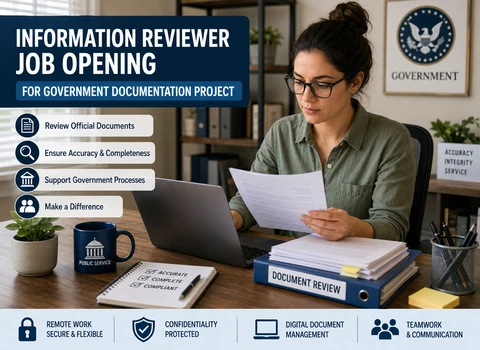
Information Reviewer Job Opening for Government Documentation Project
An
Information Reviewer Job Opening for the Government Documentation Project involves examining official records, forms, and supporting documents to ensure they meet established requirements before they move through a government process. Public agencies handle thousands of records every day, and accurate information is essential for making decisions, maintaining compliance, and delivering services efficiently.
People in this role review submitted materials, identify missing or inconsistent information, and help ensure that records are ready for processing. Their work supports the integrity of government systems and helps reduce delays caused by incomplete or inaccurate documentation.
This
remote opportunity pays $26 per hour and is well-suited to individuals who enjoy detail-oriented work, structured procedures, and careful review of information.
Why Documentation Review Plays an Important Role
Government agencies rely on accurate records to carry out a wide range of responsibilities. From issuing licenses to administering public programs, many decisions depend on information provided through applications and supporting documents.
When records contain mistakes, missing details, or conflicting information, processing often slows down. Staff may need to contact applicants, request additional documentation, or conduct further reviews before moving forward.
Information reviewers help prevent these situations by identifying issues early in the process. Their efforts contribute to smoother workflows and more reliable recordkeeping.
Documents commonly reviewed include:
- Permit applications
- Licensing paperwork
- Identification documents
- Financial records
- Benefit program forms
- Compliance documentation
- Registration materials
- Administrative records
Careful review at the beginning of the process can save time and reduce administrative burdens later.
How the Position Supports Government Projects
The primary responsibility of an information reviewer is to evaluate documents that have already been submitted. Rather than creating records, reviewers focus on verifying that information meets established standards and guidelines.
This often involves comparing documents against requirements, checking for completeness, and documenting any concerns that need attention.
Examples of issues reviewers may encounter include:
- Missing signatures
- Blank sections on forms
- Duplicate records
- Contradictory information
- Incorrect document categories
- Formatting problems
- Missing attachments
By identifying these issues before records advance through the system, reviewers help maintain consistency and accuracy across government operations.
What a Typical Day May Involve
Most work is completed through secure digital platforms. While responsibilities vary by project, many daily activities are similar across agencies and departments.
A typical day may include:
- Accessing document management systems
- Reviewing newly submitted records
- Comparing information across multiple files
- Checking compliance with established guidelines
- Recording review outcomes
- Updating tracking databases
- Communicating findings to team members
- Following security and confidentiality procedures
Some projects focus on a single document type, while others require reviewers to work with a broader range of records.
Types of Documents Commonly Reviewed
The specific records handled depend on the agency, department, or government program involved.
Examples may include:
- Tax documentation
- Healthcare enrollment forms
- Employment verification records
- Immigration-related paperwork
- Grant submissions
- Procurement documents
- Public records requests
- Regulatory filings
- Benefit applications
- Registration forms
Understanding the purpose of these documents helps reviewers recognize errors and determine whether requirements have been met.
Skills That Help Professionals Succeed
Employers typically look for candidates who can work accurately, follow procedures, and remain organized while handling large volumes of information.
Attention to Detail
A strong eye for detail is one of the most important qualities in this profession. Reviewers must identify missing information, inconsistencies, and errors that could affect processing.
Analytical Thinking
Many reviews require comparing information from multiple sources and determining whether records align correctly.
Written Communication
Clear notes and documentation help processing teams understand why a record requires correction or additional review.
Organization
Managing numerous files and maintaining accurate records require a structured approach.
Reading and Interpretation Skills
Government policies and documentation standards can be detailed. Reviewers must understand instructions and apply them consistently.
Time Management
Meeting deadlines while maintaining quality is an important part of the role.
Educational Background and Relevant Experience
Requirements vary by employer, but many positions are open to candidates with a high school diploma or equivalent, especially when they have related experience.
Educational backgrounds that may be helpful include:
- Public Administration
- Business Administration
- Information Management
- Records Management
- Legal Studies
- Political Science
- Government Administration
Experience in administrative support, compliance, auditing, records processing, customer service, or quality assurance can also provide a strong foundation for this type of work.
Certifications That May Add Value
Although certifications are not always required, they can demonstrate specialized knowledge and strengthen a candidate's professional profile.
Examples include:
- Certified Records Manager (CRM)
- Information Governance certifications
- Compliance certifications
- Quality Assurance credentials
- Data Management certifications
- Project Management coursework
Training related to records handling, document control, or information governance may also be beneficial.
Software and Systems Used in Documentation Review
Most government documentation projects rely on digital tools to manage records and workflows.
Commonly used systems include:
- Electronic document management platforms
- Records management software
- Workflow tracking systems
- Data entry applications
- Microsoft Excel
- Microsoft Word
- PDF editing and review tools
- Database software
- Case management systems
- Secure cloud-based environments
Because agencies often use specialized software, the ability to learn new systems quickly is valuable.
Challenges Associated With the Role
While the work follows established procedures, it requires concentration and consistency.
Handling Large Workloads
Some projects involve reviewing substantial numbers of records within specific deadlines.
Following Detailed Requirements
Government documentation standards can be extensive, requiring careful interpretation and consistent application.
Maintaining Concentration
Reviewing documents for long periods demands focus and attention to detail.
Protecting Confidential Information
Many records contain sensitive personal data. Reviewers must follow strict privacy and security protocols.
Balancing Accuracy and Productivity
Organizations expect reviewers to complete work efficiently without sacrificing quality.
Where Information Reviewers Find Employment
Government agencies are among the largest employers of information reviewers, but similar positions exist in other industries that depend on accurate documentation and compliance.
Organizations that may hire for these roles include:
- Federal government agencies
- State departments
- Local government offices
- Regulatory bodies
- Healthcare organizations
- Educational institutions
- Legal service providers
- Government contractors
- Compliance consulting firms
- Administrative support organizations
Opportunities may be available through full-time employment, temporary assignments, or project-based contracts.
Remote Work Expectations
Many documentation review projects can be performed remotely because records are stored electronically and accessed through secure systems.
For an
Information Reviewer Job Opening for the Government Documentation Project, employers often expect candidates to have:
- Reliable internet access
- A secure workspace
- Strong organizational habits
- Familiarity with virtual communication tools
- Professional communication skills
- The ability to work independently
Because government records frequently contain confidential information, remote employees must follow strict security guidelines and confidentiality policies.
Who Is a Good Fit for This Type of Work?
This profession often appeals to individuals who enjoy structured tasks and clear expectations.
You may be well-suited to this role if you:
- Prefer organized workflows
- Notice small details quickly
- Enjoy accuracy-focused work
- Follow procedures carefully
- Work effectively on your own
- Stay focused during repetitive tasks
- Value consistency
- Approach problems logically
People who take satisfaction in maintaining quality and ensuring accuracy often perform well in this field.
Opportunities for Future Career Growth
Experience reviewing government documentation can open doors to a variety of related careers.
Potential advancement opportunities include:
- Compliance Analyst
- Records Manager
- Documentation Specialist
- Quality Assurance Specialist
- Information Governance Coordinator
- Regulatory Affairs Specialist
- Data Quality Analyst
- Program Administrator
- Government Operations Analyst
- Audit Support Specialist
The skills developed through document review are widely applicable across administrative, compliance, records management, and governance functions.
Preparing for a Career in Information Review
Candidates interested in an
Information Reviewer Job Opening for the Government Documentation Project can improve their readiness by developing practical skills before applying.
Useful preparation steps include:
- Practicing document review and verification techniques
- Improving spreadsheet skills
- Learning basic database functions
- Studying records management concepts
- Strengthening written communication abilities
- Understanding confidentiality requirements
- Developing strong organizational habits
- Becoming familiar with workflow software
Employers often appreciate candidates who demonstrate reliability, professionalism, and a commitment to producing accurate work.
Why Information Review Remains Essential
As government agencies continue expanding digital services and electronic record systems, the need for skilled information reviewers remains important. Technology can assist with processing and organization, but human reviewers are still needed to evaluate context, identify inconsistencies, and apply judgment when reviewing documentation.
An
Information Reviewer Job Opening for the Government Documentation Project provides an opportunity to contribute to the accuracy of public records while working remotely. For individuals who enjoy careful analysis, structured responsibilities, and maintaining high standards, this role offers valuable experience and a pathway into broader careers involving compliance, records management, government administration, and information governance.