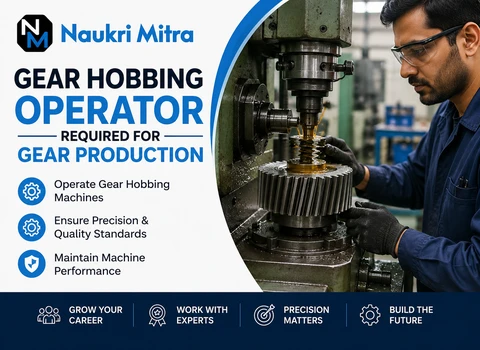
Understanding the Role of a Gear Hobbing Operator in Modern Manufacturing
Gear manufacturing is a backbone process in the engineering and automobile industries, and the person who operates the gear-cutting machine plays a central role. A Gear Hobbing Operator is responsible for producing precise, toothed gear components using a hobbing machine, a specialized piece of equipment that cuts gear teeth through a rotating cutter called a hob. This position, based in Rajkot, Gujarat, India, is currently open full-time and offers a monthly salary commensurate with the technical nature of the work.
Why Gear Production Units Need Skilled Machine Operators
Gears are used in almost every mechanical assembly, from automobile gearboxes to industrial pumps, textile machinery, and agricultural equipment. Because gear teeth must be cut with extreme accuracy to mesh correctly with other components, companies rely on trained operators who understand cutting parameters, tooling, and measurement. A small error in tooth profile or pitch can cause noise, vibration, or complete failure of a mechanical assembly, which is why this role demands attention and consistency rather than speed alone.
A Typical Day on the Shop Floor
The daily routine of an equipment operator in a gear production setup usually begins with checking the hobbing machine, verifying coolant levels, and reviewing the job card or engineering drawing for the day's production batch. Work generally includes:
- Loading raw gear blanks onto the machine spindle
- Setting cutting speed, feed rate, and hob position according to the drawing
- Running trial pieces and checking tooth profile before full production
- Monitoring the machine during continuous cutting cycles
- Inspecting finished gears using measuring instruments
- Recording production output and reporting any deviations to the supervisor
Machines, Tools and Instruments Used in Gear Cutting Work
Apart from the hobbing machine itself, a production worker in this trade regularly handles gear blanks, hobs of different modules, arbors, and coolant systems that keep the cutting edge cool and extend tool life. Measuring instruments form a major part of daily work, since dimensional accuracy cannot be judged by eye. Common instruments include vernier calipers, micrometers, dial gauges, and gear tooth calipers, along with engineering drawings that specify module, pressure angle, and number of teeth. In some units, exposure to EDM machines is also useful, particularly where tooling or fixture correction is required.
Skills That Make an Operator Job-Ready
Technical understanding of gear terminology, reading engineering drawings, and basic knowledge of metal-cutting principles are expected of candidates applying for this position. Employers often prefer people who have completed an ITI in a machining-related trade or a Diploma in Mechanical or Tool and Die Engineering, since these courses cover workshop practice and measurement in detail. Equivalent vocational training, combined with hands-on machine experience, is also considered valuable, especially for candidates who have previously worked in a tool room or machine shop.
Beyond technical knowledge, practical workplace skills matter just as much. A machine operator needs patience while setting up jobs, physical stamina to stand for long periods, and the ability to concentrate during repetitive cutting cycles without losing focus on quality.
Industries and Work Environments Where This Role Exists
Gear hobbing operators are commonly employed in automobile component manufacturing units, general engineering workshops, gearbox manufacturing plants, and machine tool industries. Gujarat, and particularly the Rajkot region, has a strong base of engineering and auto-component manufacturing activity, which creates steady demand for trained gear production professionals. Work locations typically include manufacturing plants and precision machine shops rather than open construction sites.
Working Conditions and Physical Demands
This is largely a standing job that involves working near rotating machinery, coolant, and metal shavings. Shift-based work is common in production units, so candidates should be prepared for rotational shifts as required by factory operations. The environment can be noisy due to running machines, and operators are expected to remain alert throughout their shift, since gear cutting requires continuous monitoring rather than one-time setup.
Safety Practices and Protective Equipment
Working around cutting tools and moving machine parts requires strict safety discipline. Operators are usually required to use safety shoes, protective gloves during material handling, and safety goggles to protect against metal chips. Loose clothing is avoided near rotating spindles, and machine guards should never be bypassed. Following standard operating procedures reduces the risk of injury and also protects the quality of the finished gear.
Common Challenges Faced by Operators
New operators sometimes struggle to achieve consistent tooth accuracy across a full production batch, especially when hob wear begins to affect cut quality. Coolant management, proper clamping of gear blanks, and early identification of tool wear are practical challenges that improve with experience. Building the habit of frequent in-process checking, rather than inspecting only at the end, is one of the most effective ways to reduce rejection.
Growth Opportunities Within Gear Manufacturing
With experience, a gear hobbing operator can progress toward handling more complex gear profiles, operating CNC gear hobbing machines, or taking up quality inspection responsibilities within the same production line. Senior operators are often given responsibility for training new staff or overseeing machine setup for critical jobs, which naturally builds toward supervisory roles over time within the gear manufacturing trade.
Salary and Employment Benefits
This full-time position in Rajkot, Gujarat, India offers a monthly salary of ₹30,000. Depending on company policy, additional benefits may include overtime pay, Provident Fund (PF), Employee State Insurance (ESI), yearly bonus, uniforms, and in some cases transport or canteen facilities. These benefits vary by employer and should be confirmed directly during the hiring process.
For freshers, ITI pass-outs, diploma holders, and experienced machinists looking to build a long-term career in precision manufacturing, this Gear Hobbing Operator role offers practical, hands-on exposure to an essential part of the engineering industry, with clear scope to grow into more advanced machine handling and supervisory responsibilities over time.