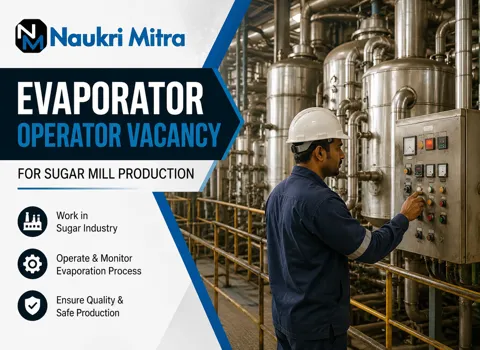
What an Evaporator Operator Actually Does in a Sugar Mill
Walk into the boiling house of any sugar mill and you'll hear it before you see it — the low hiss of steam, pipes running overhead, gauges lined up in rows. This is where the Evaporator Operator works. Cane juice arrives here already clarified, but it's still mostly water. The operator's job is to boil that water off in stages, using a bank of connected vessels, until what's left is a thick syrup ready for crystallization. This Full-time position, based in Belagavi, Karnataka, India, pays ₹34,800 per month and offers someone with the right aptitude a real foothold in sugar processing.
Why This Station Matters More Than It Looks
It's easy to underestimate a job that looks like "watching gauges," but a few degrees of temperature error or a poorly timed valve adjustment here can throw off sugar recovery for an entire batch. Mills don't hand this station to just anyone. Fuel costs, sugar yield, and even the color of the final product are partly traceable to how well the evaporators are run. That's the real reason experienced hands are valued in this role — the margin for error is thin.
A Shift Isn't Just Sitting and Watching
Most days start with a look at the previous shift's logbook — steam pressure, juice flow, any bodies that were giving trouble. From there it's a constant back-and-forth: checking Brix readings, adjusting vacuum, listening for anything that sounds off in the vapor lines. Some hours are quiet. Others, especially when a body starts scaling or juice threatens to carry over, get busy fast.
Day to day, the work tends to fold in a few recurring tasks:
- Tracking juice level and density across each evaporator body
- Adjusting steam and vacuum to keep concentration steady
- Watching condensers and vapor lines for irregularities
- Staying in sync with the pan house on syrup quality
- Logging readings for every hour of the shift
Starting Up, Cleaning, Shutting Down
Beyond routine monitoring, the operator handles the less glamorous but equally important parts — starting and stopping sets safely, scraping and descaling the tubes when scale buildup slows heat transfer, and ensuring juice doesn't creep into places it shouldn't. At the start of the crushing season there's a boiling-out procedure to get the whole line ready, and at the end, a shutdown routine that needs just as much care.
The Equipment You'll Get to Know
Multiple-effect evaporator bodies, vacuum pans, condensers, steam traps, and Brix refractometers make up the core toolkit here. Newer mills run much of this through automated control panels; older setups still lean on manual valve work, so an operator often ends up comfortable with both approaches by the end of a season.
Who Tends to Do Well in This Role
ITI pass-outs and diploma holders in Mechanical or Sugar Technology are usually the first candidates mills look at, though this isn't a hard rule — plenty of good operators started as helpers and learned on the job. What tends to matter more is a working sense of steam behavior, comfort reading gauges without hesitation, and the instinct to notice when something's drifting before it becomes a problem. Anyone coming from boiler house work usually picks up evaporator duties faster than most.
Heat, Noise, and Standing Shifts
There's no getting around it — this is a warm, humid station, with steam noise in the background for most of the shift. Standing for long stretches is normal. Because crushing runs around the clock during the season, shifts rotate, and night duty is the norm rather than the exception.
Safety Comes First, Not as an Afterthought
Steam and hot metal don't forgive carelessness. Safety shoes, heat-resistant gloves, protective goggles, and mill-issued uniforms are the baseline PPE here. Beyond that, it's habits that keep people safe — following lockout steps before touching anything under maintenance, and never sitting on a steam leak instead of reporting it immediately.
What Tends to Go Wrong
Pressure swings that need a quick response, scale that creeps up inside the tubes faster than expected, juice carryover on a busy shift — these are the recurring headaches. Add to that the longer hours during peak crushing season, and it's clear this isn't a role for someone looking for a predictable nine-to-five.
Where This Can Lead
Operators who stick with it and keep learning often move up to senior operator charge, and eventually into shift-in-charge or boiling house supervisory positions. Mills increasingly value operators who understand energy-efficient evaporation methods and newer automation systems, so picking up that knowledge along the way tends to pay off over time.
Pay and What Might Come With It
The role pays ₹34,800 per month, Full-time, at a sugar mill location in Belagavi, Karnataka, India. Beyond the base pay, some mills also offer overtime, PF, ESI, bonus, uniforms, transport, or canteen access — though this depends entirely on the individual employer's policy and shouldn't be assumed going in.
Worth Considering If...
If steady, hands-on technical work appeals to you, shift rotations don't put you off, and you'd like a stable place in India's agro-processing sector, this is a reasonable entry point — and, for many, it turns into a long-term career within sugar mill operations rather than just a first job.