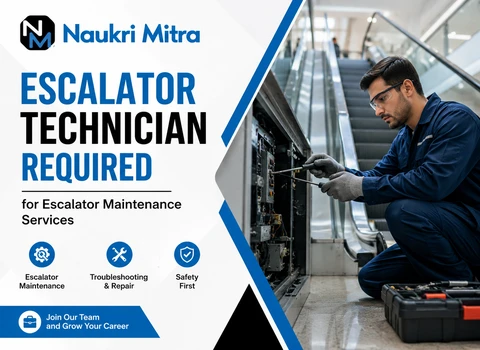
Who Actually Fixes the Escalator When It Stops
You've probably stood on a stalled escalator at some point, wondering why it just stopped mid-ride. Somebody has to come sort that out. That somebody is usually an Escalator Technician, and the job is less glamorous than it sounds but more hands-on than most people assume. Half the work is mechanical, half is electrical, and you need patience for both.
Why Malls and Metro Stations Hire for This
Underneath every escalator panel sits a mess of chains, rollers, a motor, handrail belts, and sensors that will shut the whole thing down the second something feels wrong. A chain that's a bit loose today is a jammed step next week. Nobody wants a stuck escalator in a packed metro station at 6pm, which is exactly why escalator maintenance services keep technicians on staff instead of scrambling only after something breaks.
A Day That Rarely Goes to Plan
There's a schedule, sure. Mornings might mean a routine check at one mall. But plans shift fast if a call comes in about a jammed step somewhere else. On a normal day you'd be:
Checking chains and rollers for wear
Greasing moving parts
Testing the emergency stop and safety sensors
Chasing down electrical faults in the control panel
Writing up a quick service report before moving on
Some visits wrap up in twenty minutes. Others turn into a three-hour job because a part needs replacing and nobody stocked a spare.
The Calls That Come at the Worst Time
Breakdowns don't wait for convenient hours. Evening rush, a weekend at the mall, mid-morning at a metro station — that's usually when the phone rings. An equipment operator on one of these calls has to decide fast: quick fix, or does this need the escalator shut down for a proper repair? Swapping a worn motor part while a supervisor hovers and shoppers walk past is just a Tuesday in this trade.
Sites You'll End Up Working At
Malls and retail complexes make up a good chunk of the work. Add metro and railway stations, airports, office towers, multiplexes. In a city like Mumbai, these sites sit close together, so it's common to hit three or four locations in one day without wasting half the day stuck in traffic between them — though traffic still eats time; more on that later.
What's Actually in the Toolbag
Spanners, screwdrivers, the usual. A multimeter is used constantly to trace faults in the wiring. Chain tension gauges tell you if a chain needs adjusting or if it's done for. Some employers hand out diagnostic units that pull fault codes right off the control board — saves a lot of guesswork compared to testing every part by hand one at a time.
Skills That Separate a Good Technician from a Struggling One
Training gets your foot in the door. What keeps you employed is different:
Reading a wiring diagram without needing help
Knowing how a motor and gearbox should sound and feel under load
Being fine working in a cramped pit or up near the top landing
Not panicking when the fault doesn't show up on the first two checks
Explaining what's wrong to a supervisor who has zero technical background
Employers may prefer candidates with relevant machining or tool room training. Depending on the complexity of the work, an ITI in a machining-related trade, a Diploma in Mechanical or Tool and Die Engineering, or equivalent vocational training may be considered suitable. Practical experience with EDM machines, engineering drawings, and precision measuring instruments is often valued as much as formal education.
Yes, It's Physical Work
Bending into pits, climbing, standing around for long stretches, lugging a toolbag between floors. There's no getting around that part. And because escalators run in public spaces, some servicing happens late at night or during off-peak hours so it doesn't get in anyone's way — so odd shift timings aren't rare here, they're normal.
What Safety Looks Like on the Ground
You're working near moving parts in a space full of the public, so shortcuts don't fly. Safety shoes and gloves, always. Harnesses come out for certain jobs. Before touching anything internal, the machine is switched off and isolated; barriers go up; people are cleared away. Bypassing a sensor because "it'll just take a second" is the kind of thing that gets someone hurt, and it's not tolerated.
What Actually Gets Frustrating
Traffic between sites eats more time than anyone budgets for — an hour lost just getting from one mall to the next station during peak hours isn't unusual. Then there's the intermittent fault that trips a sensor randomly and then behaves perfectly the moment you're there checking it. Takes two or three visits sometimes just to catch it acting up. It's the kind of thing that tests patience more than it tests skill.
Moving Up Over Time
A few years in, most technicians start handling more complicated control systems on their own, or end up supervising the newer guys on the team. Working across different escalator brands and control panel types over time is basically what qualifies someone for bigger, busier sites down the line.
What This Role Pays
This Escalator Technician position is based in Mumbai, Maharashtra, India, offered on a Full-time basis, at a monthly salary of ₹31,500 — roughly in line with what a skilled maintenance role like this pays in the region.
What Might Come Along With It
Depends on the employer, but roles like this sometimes come with PF contributions, ESI coverage, uniforms, overtime for extended callouts, and occasionally transport or canteen access at certain sites. Not guaranteed everywhere, so worth checking directly rather than assuming.